


Author(s) :
Andreea Maria Costache1, Claudia Florina Radu1, Maria Francesca Coada1
1 Fundeni Clinical Institute, Bucharest, Romania
Corresponding author: Andreea Maria Costache, Email: andreea.23.dwarf@gmail.com
Publication History: Received - 24 October 2025, Revised - 7 December 2025, Accepted - 31 December 2025, Published Online - 31 December 2025.
Copyright: © 2025 The author(s). Published by Casa Cărții de Știință.
User License: Creative Commons Attribution – NonCommercial (CC BY-NC)

 PDF
PDF
 Share
Share
Highlights
- First-line systemic therapy with atezolizumab and bevacizumab successfully regressed a 6 cm tumor and resolved portal vein tumor thrombosis (PVTT),
- The significant radiological response allowed for Transarterial Chemoembolization (TACE), ultimately achieving a complete response (CR) with no visible tumor tissue on follow-up imaging.
- Despite the lack of established guidelines for this specific scenario continued systemic therapy post-procedure may mitigate the high risk of recurrence associated with vascular invasion.
Abstract
Hepatocellular carcinoma (HCC) complicated by portal vein tumor thrombosis (PVTT) typically represents an advanced disease stage, with limited treatment options and poor prognosis. Systemic therapy with atezolizumab and bevacizumab has shown promising results in such cases. We report the case of a 60-year-old male with hepatitis B-related cirrhosis and a 6 cm HCC nodule, initially classified as Barcelona Clinic Liver Cancer(BCLC )stage B. The patient began first-line systemic therapy with atezolizumab and bevacizumab. Following stable disease, a brief treatment interruption due to thrombocytopenia led to disease progression with newly developed PVTT. Treatment was subsequently resumed, and the patient showed good tolerability and clinical response. After four cycles, imaging revealed significant tumor regression and complete remission of PVTT enabling transarterial chemoembolization (TACE). Post-procedure imaging revealed a complete response. Adjuvant systemic therapy was continued to reduce the risk of recurrence.
This case highlights the potential for atezolizumab-bevacizumab to downstage HCC with PVTT, making local treatment feasible. It supports the role of immunotherapy-based treatment not only as palliative care but also as part of a multimodal therapeutic approach. Continuing systemic therapy post-TACE may benefit selected high-risk patients, even though current guidelines are limited.
1. Introduction
Hepatocellular carcinoma (HCC) is the most common primary liver cancer and represents the fifth most frequently diagnosed cancer worldwide and the second leading cause of cancer death among men (1). Due to HCC’s biology, these cells often invade intrahepatic vessels, especially the portal vein, leading to portal vein tumor thrombosis (PVTT) (2). Portal vein thrombosis is common and linked with poor prognosis (3). Without treatment, median survival is 2.7 months (4).
2. Case report
Herein, we report a 60-year-old male with hepatitis B-related cirrhosis diagnosed in 2020 and treated with Entecavir. In January 2024, routine ultrasound found a suspicious nodule. A confirmatory CT scan showed a 6 cm HCC nodule in hepatic segments VII/VIII (BCLC B) without intra- or extra-hepatic metastases. Liver biopsy confirmed grade 1 (G1) HCC. Upper GI endoscopy showed no esophageal varices. Laboratory results classified cirrhosis as Child-Pugh class A.
After a complete evaluation, the patient began first-line systemic treatment with Atezolizumab and Bevacizumab in February 2024. After four months, the therapy was interrupted due to thrombocytopenia (platelets <100,000/mm³). Imaging showed stable disease (Fig. 1A). In September 2024, the patient visited our clinic for a second opinion. Initial evaluation showed a good performance status and no complaints. Labs revealed mild hepatocellular injury, iron deficiency, and grade I thrombocytopenia (90,000/mm3), while AFP within the normal range (3.90 ng/ml). At that time, since the single 6 cm nodule had remained stable (Fig. 1B), we considered a local intervention appropriate, and the case was discussed at the multidisciplinary board. However, the latest CT scan subsequently showed disease progression: although the nodule size remained stable, PVTT had developed (Fig. 1C). Based on these findings, the decision was made to initiate systemic treatment.
Atezolizumab and Bevacizumab were restarted due to good tolerability and response. The patient then received 1875 mg Atezolizumab subcutaneously and, Bevacizumab 800 mg per cycle; Bevacizumab was omitted if the platelets fell below 70,000/mm3 with only 2 doses missed to date. Treatment related adverse events were limited to grade I: mild epistaxis, minor gingival bleeding, and thrombocytopenia.
After four well-tolerated treatment cycles, imaging revealed regression of the HCC nodule and remission of PVTT (Fig 1D). These favorable findings prompted reconsideration of local therapy. The multidisciplinary team agreed the patient for a local procedure.
On January 27, 2025, TACE was performed on the HCC nodule without complications. Post-procedure the patient developed cholestasis (total bilirubin 2.2 mg/dl) and grade II thrombocytopenia (platelets counted 63,000/mm3). By February, cholestasis had resolved, and platelet count rose above 100,000/mm3. Follow-up imaging, one month post-TACE, revealed no residual tumor (Fig. 2). The patient continues systemic therapy with atezolizumab and bevacizumab as adjuvant treatment.
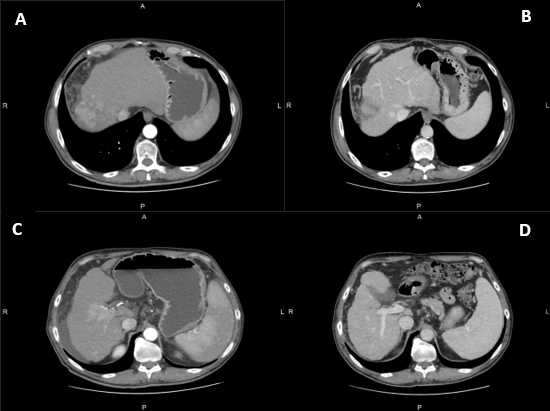
Figure 1. Follow-up CT scans. A- HCC nodule in April 2024; B- HCC nodule in December 2024; C- HCC nodule with PVTT in August 2025; D- regression of the PVTT after Atezolizumab and Bevacizumab in December 2025.
Figure 2. Complete remission of the liver nodule after systemic treatment and TACE.
3. Discussion
We report the case of a patient with HCC with PVTT staged as BCLC C. After administrations of atezolizumab and bevacizumab, a significant regression of PVTT was observed allowing a local treatment approach for the HCC nodule.
The choice of local treatment was challenging due to the high recurrence rate of HCC. Curative options include surgery, liver transplantation, and local ablation; however, most patients are only eligible for non-curative options, such as TACE (5). Liver transplantation is the most comprehensive curative approach for HCC, since it removes both the tumor and the underlying liver disease but is limited by donor shortages and perioperative risks. Hepatectomy is a commonly used surgical option, but it is contraindicated in patients with significant liver dysfunction. In advanced or recurrent HCC, combining hepatectomy with non-surgical treatments, such as local ablation or TACE, has become more common (6). TACE plays a key role across all HCC stages, mainly as first-line therapy for intermediate-stage disease. In the immunotherapy era, combining TACE with systemic immunotherapy represents a promising approach for unresectable HCC. Given its palliative intent, repeat TACE is often needed to improve tumor control. Studies show it can provide a survival benefit (7). Considering surgical risks in patients with HCC and cirrhotic liver, as well as the high recurrence rate of HCC, we opted for TACE while preserving liver function. The procedure can be repeated in case of recurrence.
Also, we would like to highlight the role of atezolizumab and bevacizumab as a first-line treatment option. The results of the IMbrave150 trial have established this combination as the standard of care for first-line treatment of unresectable HCC, including patients with macrovascular invasion, such as PVTT, historically associated with poor prognosis (8).Our case demonstrates regression of PVTT with this treatment suggesting potential benefit, even in advanced disease with vascular involvement.
Recent evidence has explored the role of combination in adjuvant setting. The IMbrave050 trial evaluated this combination after curative resection or ablation in high-risk patients. At interim analysis, adjuvant therapy significantly improved recurrence-free survival (RFS) compared to active surveillance, with about a 28% reduction in the risk of recurrence or death (9). Importantly, the benefit was most pronounced in subgroups with high-risk features, such as vascular invasion or large tumors. However, longer-term follow-up suggested that the early RFS advantage may attenuate over time, and overall survival data remain immature (9,15).
Currently, no major guidelines, including NCCN or ESMO, recommend routine adjuvant systemic therapy for HCC following curative resection or ablation. While the IMbrave050 trial indicates that select high-risk patients may derive benefit, such use remains investigational and should generally be reserved for clinical trials or individualized treatment plans (9,15). In our case, given the patient’s high-risk disease and excellent tolerance to therapy over two years, we opted to continue systemic treatment with adjuvant intent. The plan is to continue for eight additional cycles, followed by chest CT and abdominal/pelvic MRI every three months
According to the Chinese Liver Cancer staging system adjuvant treatment is advised for individuals having risk factors for recurrence, such as tumors larger than 5 cm, the presence of more than three nodules, micro- or macrovascular invasion, or poor histological differentiation (11-13). The optimal duration of adjuvant immunotherapy and targeted therapy after curative resection in HCC remains uncertain (13-14).
Although EMERALD 1 (15) looked at durvalumab plus bevacizumab in combination with TACE in patients with embolization-eligible intermediate-stage HCC rather than in an adjuvant setting, it serves as a useful comparator for combination systemic plus locoregional therapy. In EMERALD 1, the addition of durvalumab and bevacizumab to TACE significantly improved progression-free survival (PFS) compared to TACE alone (median 15.0 vs 8.2 months; HR 0.77; p = 0.032). Additionally, the experimental arm had higher objective response rates (~43.6%) than TACE alone (~29.6%). Responders had a median response duration of over 22 months, indicating long-term tumor control. Detailed information on complete responders and subsequent locoregional or curative interventions was not provided.
A recent phase II study evaluating the combination of TACE with atezolizumab and bevacizumab found promising antitumor activity and favorable survival outcomes in BCLC B disease, implying that VEGF inhibition and T-cell activation may improve the effects of ischemic cytotoxic therapy (16). Similarly, the phase III LEAP-012 trial found that adding lenvatinib and pembrolizumab to TACE significantly improved PFS compared to TACE alone, confirming that blocking the VEGF/PD-1 pathway can enhance locoregional responses (17). These findings were supported by EMERALD-1, which showed that durvalumab combined with TACE improved PFS and yielded complete responses in a subset of patients, highlighting the potential value of systemic therapy for consolidation and recurrence prevention following locoregional control. Our case also shows a strong tumor response with atezolizumab plus bevacizumab followed by TACE, including the regression of PVTT, implying that combining systemic immunotherapy and anti-VEGF therapy with locoregional treatment can provide significant tumor control, even when durvalumab + TACE is not available (15).
4. Conclusion
This case highlights the role of palliative systemic therapy with atezolizumab and bevacizumab in downstaging advanced hepatocellular carcinoma with PVTT, a condition usually associated with poor prognosis and limited options for curative treatment. The significant radiological response achieved enabled a transition to locoregional treatment with TACE, resulting in a complete response. Considering the high recurrence risk in cases with vascular invasion, the continuation of systemic therapy with adjuvant intent may confer additional clinical benefit. This case supports a multimodal, individualized approach and emphasizes the evolving role of immunotherapy in both palliative and potentially curative settings for selected high-risk HCC patients.
Abbreviations
BCLC – Barcelona Clinic Liver Cancer staging system
CT – Computed tomography
HCC – Hepatocellular carcinoma
MRI – Magnetic resonance imaging
PVTT – Portal vein tumor thrombosis
PFS–Progression-free survival
TACE – Transarterial chemoembolization
Statements
Authors’ contributions: MFC conceived and planned the manuscript; AMC took the lead in writing the manuscript; CFR made the final approval. All authors provided critical feedback and helped shape the research, analysis, and manuscript.
Consent for publication: As the corresponding author, I confirm that the manuscript has been read and approved for submission by all named authors.
Conflict of interest: The authors declare no conflict of interest.
Funding: None.
Ethical approval: The case management was approved by Fundeni Clinical Institute tumor board
Informed consent: The informed consent was obtained from the patient for publication of this case report and any accompanying images.
References
- Asafo-Agyei KO, Samant H. Hepatocellular Carcinoma. [Updated 2023 Jun 12]. In: StatPearls [Internet]. Treasure Island (FL): StatPearls Publishing; 2024 Jan-. Available from: https://www.ncbi.nlm.nih.gov/books/NBK559020/
- Song WJ, Xu J, Ni Y, Liu W, Li J, Yang L, et al. Conversion therapy of a giant hepatocellular carcinoma with portal vein thrombus and inferior vena cava thrombus: a case report and review of literature. World J Clin Cases. 2024;12(16):2847-55.
- Quirk M, Kim YH, Saab S, Lee EW. Management of hepatocellular carcinoma with portal vein thrombosis. World J Gastroenterol. 2015;21(12):3462-71.
- Llovet JM, Bustamante J, Castells A, Vilana R, Del M, Sala M, et al. Natural history of untreated nonsurgical hepatocellular carcinoma: Rationale for the design and evaluation of therapeutic trials. Hepatology. 1999;29(1):62-7.
- Torimura T, Iwamoto H. Treatment and the prognosis of hepatocellular carcinoma in Asia. Liver Int. 2022;42(9):2042-54.
- Kishi Y. Role of hepatectomy for recurrent or initially unresectable hepatocellular carcinoma. World J Hepatol. 2014;6(12):836-43.
- Zhong BY, Jin Z, Chen JJ, Zhu HD, Zhu X. Role of Transarterial Chemoembolization in the Treatment of Hepatocellular Carcinoma. J Clin Transl Hepatol. 2023;11(2):480-9.
- Finn RS, Qin S, Ikeda M, Galle PR, Ducreux M, Kim TY, et al. Atezolizumab plus Bevacizumab in Unresectable Hepatocellular Carcinoma. N Engl J Med. 2020;382(20):1894-905.
- Hack SP, Spahn J, Chen M, Cheng AL, Kaseb A, Kudo M, et al. IMbrave 050: a Phase III trial of atezolizumab plus bevacizumab in high-risk hepatocellular carcinoma after curative resection or ablation. Future Oncol. 2020;16(15):975-89.
- Chamseddine S, LaPelusa M, Kaseb AO. Systemic Neoadjuvant and Adjuvant Therapies in the Management of Hepatocellular Carcinoma—A Narrative Review. Cancers (Basel). 2023;15(13):3508.
- Zhou J, Sun H, Wang Z, Cong W, Zeng M, Zhou W, et al. Guidelines for the Diagnosis and Treatment of Primary Liver Cancer (2022 Edition). Liver Cancer. 2023;12(5):405-44.
- Singal AG, Llovet JM, Yarchoan M, Mehta N, Heimbach JK, Dawson LA, et al. AASLD practice guidance on prevention, diagnosis, and treatment of hepatocellular carcinoma. Hepatology. 2023;78(6):1922-65.
- Zhong JH. Adjuvant therapy for hepatocellular carcinoma: Dilemmas at the start of a new era. World J Gastroenterol. 2024;30(4):806-10.
- Li L, Wu PS, Liang XM, Chen K, Zhang GL, Su QB, et al. Adjuvant immune checkpoint inhibitors associated with higher recurrence-free survival in postoperative hepatocellular carcinoma (PREVENT): a prospective, multicentric cohort study. J Gastroenterol. 2023;58(10):1043-54.
-
Sangro B, Kudo M, Erinjeri JP, Qin S, Ren Z, Chan SL, et al. Durvalumab with or without bevacizumab with transarterial chemoembolisation in hepatocellular carcinoma (EMERALD-1): a multiregional, randomised, double-blind, placebo-controlled, phase 3 study. Lancet. 2025;405(10474):216-232.
-
Wang K, Feng J, Yu H, Cheng Y, Hiang Y, LiuZ et al. Transarterial chemoembolization plus atezolizumab and bevacizumab in patients with intermediate hepatocellular carcinoma: a single-arm, phase 2 trial. Signal Transduct Target Ther. 2025;10(1):328. Published 2025 Oct 6. doi:10.1038/s41392-025-02427-0
-
Kudo M, Ren Z, Guo Y, Han G, Lin H, Zheng J et al. Transarterial chemoembolisation combined with lenvatinib plus pembrolizumab versus dual placebo for unresectable, non-metastatic hepatocellular carcinoma (LEAP-012): a multicentre, randomised, double-blind, phase 3 study. Lancet. 2025;405(10474):203-215. doi:10.1016/S0140-6736(24)02575-3