

Author(s) :
Richa Arunendu1, Deepak Gupta1, Shyam Bisht1, Susovan Banerjee1, Kushal Narang1, Mayur Mayank1, Sorun Shishak1, Tejinder Kataria11
1Department of Radiation Oncology, Medanta the Medicity, Gurgaon, India
Corresponding author: Deepak Gupta, Email: richa.arunendu@gmail.com
Publication History: Received - 21 September 2025, Revised - 20 March 2026, Accepted - 30 April 2026, Published Online - 30 September 2026.
Copyright: © 2026 The author(s). Published by Casa Cărții de Știință.
User License: Creative Commons Attribution – NonCommercial (CC BY-NC)
 Share
Share
Highlights
- Major extranodal extension (>2 mm) in oral cavity cancer remains associated with poor outcomes despite surgery and adjuvant chemoradiation.
- In 62 patients, 58% experienced treatment failure, predominantly at distant sites, while no marginal failures were observed.
- Median overall survival was 44.3 months and median disease-free survival 24.2 months, with 5-year rates of 47% and 38.7%, respectively.
- Pan, gutka and tobacco chewing independently predicted worse outcomes, with 5-year disease-free survival of only 14.4% in tobacco users.
Abstract
Objective: To analyze the outcomes and failure pattern in major (>2 mm) extranodal extension (ENE) in oral cavity cancers receiving multimodality treatment.
Materials and Methods: In this single institution cohort study, we prospectively collected and analyzed the clinical and radiological data of 62 consecutive patients with major ENE (>2mm) positive resectable oral cavity cancers treated with multimodality therapy, between January 2015 to December 2021.
Results: 62 patients (7/62 (11.2%) women and 55/62 (88.7%) men; median [range] age, 56 [27 – 86] years) with stage IV major ENE positive oral cavity cancers were treated by postoperative chemoradiation. The median follow-up was 98 months (ranging from 5.17 to 121 months). 36/62 (58%) failures were observed, among them the majority of failures i.e. 16/36 patients (44.4%) occurred at distant metastatic sites, and 13/36 patients (36.1%) had infield recurrences. Notably no marginal failure was observed. The median overall survival (OS) was 44.27 months. The median disease-free survival (DFS) was 24.17 months. Multivariate analysis showed that Pan/Gutka/Tobacco chewing was significantly associated with worse 5-year DFS and OS of 14.4% and 35.6% respectively.
Conclusion: Distant failure (50 – 58%) was the predominant cause of treatment failure and combined with the history of tobacco intake, it further led to poor survival outcomes.
1. Introduction
ENE (Extranodal extension) is defined as extension of the tumor cells through the lymph node capsule into the surrounding connective tissue. ENE in head and neck cancer was first described by Willis1 in autopsy material from a head and neck epidermoid carcinoma in 1930. Its prognostic importance was confirmed in subsequently2. It presents a challenge to disease clearance regionally but more importantly, also augments risk of distant metastasis3,4.
ENE is found in up to 20% of patients at the time of their initial surgery5. The eighth edition of the American Joint Committee on Cancer (AJCC) staging manual has incorporated ENE as a poor prognostic indicator, reflecting the significance of ENE for cancer management, but not by quantification of the size of ENE6. Although ENE classified as major (>2 mm) has been associated with worse overall survival compared to minor (≤2 mm) ENE7,8.
Pooled analysis and long-term follow up of two prospective randomized controlled trials (RTOG 9501 and EORTC 22931) show that patients with locally advanced head and neck cancer with ENE benefit from adjuvant cisplatin-based chemoradiation over radiation therapy alone (9-12).
Despite aggressive treatment approach, oral cavity cancers with major ENE (>2 mm) remain challenging to treat, with poor overall survival and high recurrence rates.
2. Methods and Materials
- Patients
We prospectively collected the clinical and radiological data of 62 consecutive patients with pathologically detected major ENE (>2mm) in primary squamous cell carcinoma of the oral cavity from January 2015 to December 2021. Patients were included with up-front surgery of the primary tumor and neck dissection with high-risk pathological feature of major ENE necessitating chemoradiotherapy, an Eastern Cooperative Oncology Group (ECOG) performance status of <2, no distant metastasis at presentation.
The exclusion criteria for the study were as follows: patients with an ECOG performance status of ≥2, those who received neoadjuvant chemotherapy before primary surgical resection, patients with positive high risk features other than ENE, cases where the surgical resection was done with palliative or debulking intent, patients with recurrent head and neck malignancies, and individuals with a prior history of radiation therapy (RT) to the head and neck region.
As part of the pretreatment evaluation, a complete medical history was taken, followed by a physical examination including fiberoptic nasopharyngoscopy. Imaging studies such as computed tomography (CT) and/or magnetic resonance imaging (MRI) of the head and neck were performed.
In addition, other imaging techniques like a plain radiograph, CT of the chest, or positron emission tomography (PET) were also included to assess the extent of the disease. Although the American Joint Committee on Cancer (AJCC) 7th edition was utilized for staging and management at the time of treatment, the AJCC 8th edition was applied to incorporate extranodal extension (ENE).
- Treatment
All patients underwent appropriate surgical management of the primary tumor and adjuvant chemo-radiotherapy (RT) was initiated within 4 to 6 weeks post-surgery. Concurrent chemotherapy, consisting of weekly cisplatin (40 mg/m²) or carboplatin (AUC 2), was indicated in patients with positive resection margins or extranodal extension (ENE). For adjuvant chemoradiotherapy (CRT) planning, patients were generally considered for weekly cisplatin. However, elderly patients or those deemed unfit for cisplatin received carboplatin or cetuximab instead.
The clinical target volume (CTV) for radiation included the post-operative tumor bed with a 1 cm margin, along with the ipsilateral nodal volumes, based on the risk factors identified in the post-operative histopathological report and the potential sites of clinical and nodal spread. The planning target volume (PTV) was created by adding a 0.5 cm uniform margin to the CTV to accommodate setup and motion errors. Radiotherapy was delivered using 6 MV photons to a dose of 64–66 Gy with a 2-Gy dose fractionation, one fraction per day, 5 days a week, using volumetric modulated arc therapy (VMAT) via a linear accelerator (Infinity and Synergy; Elekta) or TomoTherapy® (Accuray).
Patient follow-up was conducted weekly during treatment, every 2 to 3 months for the first 2 years, and then every 4 to 6 months thereafter. Post-treatment imaging, including PET and CT or MRI of the neck, was performed 3 months after treatment. Subsequent imaging studies were done as clinically indicated. Recurrences, whether locoregional or distant, were confirmed by biopsy unless clear radiographic evidence of metastatic disease was present.
- Statistics
Primary endpoint was to assess the pattern of locoregional, and distant failures and secondary end point was to evaluate the survival outcomes: disease-free survival (DFS) and overall survival (OS).
Local treatment failure was defined as recurrence at the site of the initial primary tumor, regional treatment failure as the development of recurrence in cervical lymph nodes. It could further be classified as marginal failure defined as recurrence at the radiation field margins, out of field loco-regional failure defined as recurrence at any other head and neck site not included in the radiation field.
Distant failure was defined as the appearance of widespread metastasis at other sites like lung, bone, distant lymph nodes, liver etc., outside the radiation fields. All time intervals were calculated from the date of diagnosis to the date of the event of interest. DFS was defined as the time from the day of diagnosis to the date of failure (either locoregional or distant or both) or death. Statistical analysis was performed with SPSS statistical software package for Mac (version 29.0.2.0; IBM, NY, USA). All survival analyses were performed using the Kaplan-Meier method.
3. Results
- Clinicopathological factors (Table 1)
| Characteristics | Total patients (n=62) |
|---|---|
| Mean Age: Years (Range) | 56 years (27-86) |
| Sex: Male / Female | 55 (88.7%) / 7 (11.29%) |
| Tobacco intake: Yes / No | 28 (45.16%) / 34 (54.8%) |
| Comorbidity: Yes / No | 33 (53.2%) / 29 (46.7%) |
| Tumour subsite: Buccal mucosa / Tongue / Alveolus / Retromolar trigone / GBS | 26 (41.9%) / 26 (41.9%) / 8 (12.9%) / 1 (1.61%) / 1 (1.61%) |
| Tumour Stage (AJCC-8th): Stage IVa / Stage IVb | 18 (29%) / 44 (70.9%) |
Table 1: Patient and tumour characteristics
The median age was 56 years (range, 27 to 86 years) with a male: female incidence ratio of 7.85:1. All patients had stage IV disease.
- Failure patterns
Out of the 62 patients studied, 36 (58%) experienced treatment failures, predominantly distant. Specifically, 13/36 patients (36.1%) had in-field recurrences (within the radiation field), while 2/36 patients (8.3%) developed second primary tumors outside the radiation field within the head and neck region. Importantly, there were no cases of marginal failure.
Additionally, 5/36 patients (13.8%) experienced both in-field recurrences and distant metastasis, and widespread distant metastatic recurrence was observed in 16/36 patients (44.4%), out of which 14 patients had lung metastasis, 12 patients had bone metastasis, 4 patient had liver metastasis, 3 patient had muscle metastasis and 1 patient had brain metastasis. Most patients had a combination of these organs as metastatic sites.
- Survival analysis and prognostic factors
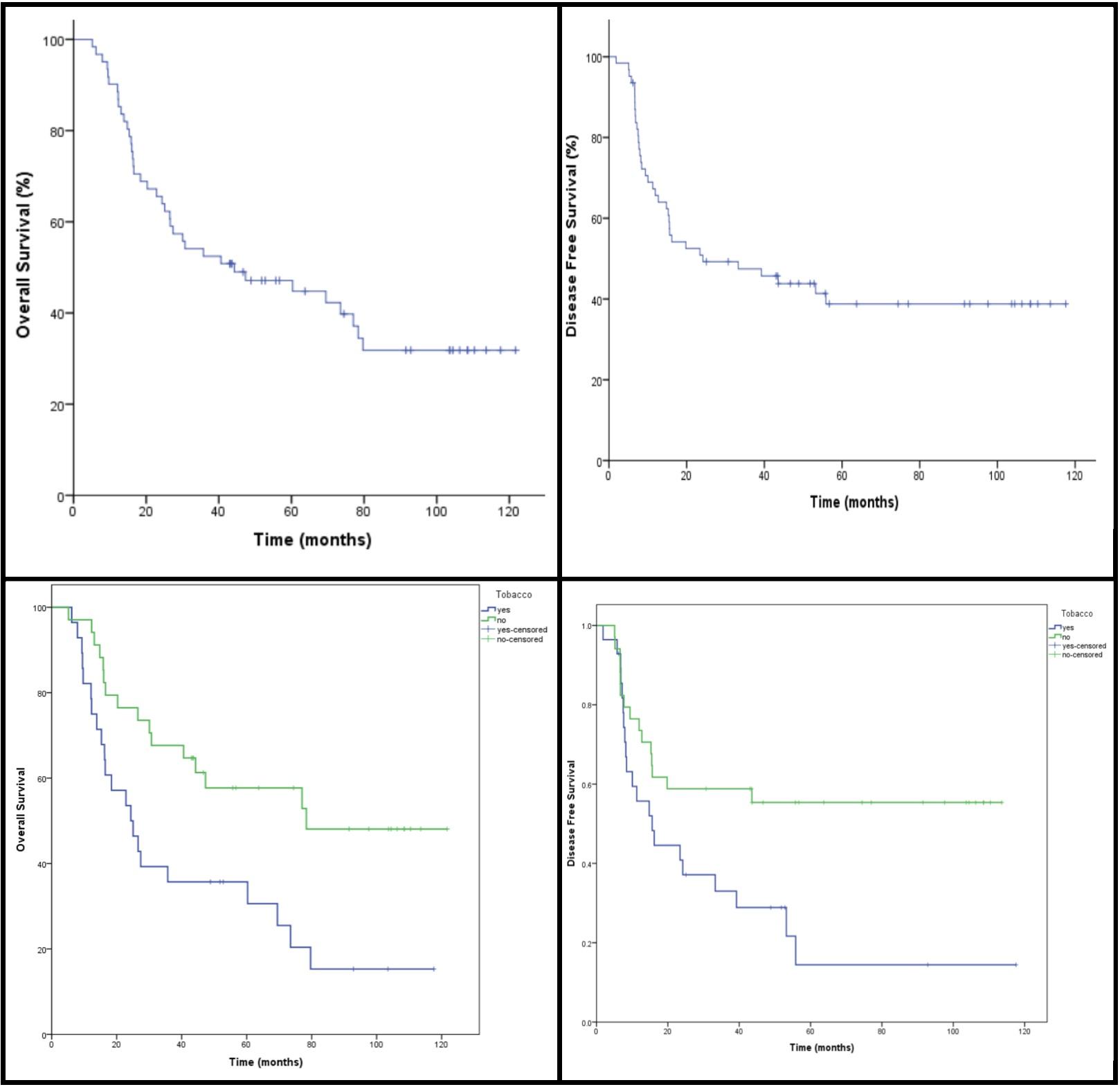
Figure 1 (A, B, C, D)
The median follow-up duration was 98 months (ranging from 5.17 to 121 months). The median overall survival (OS) duration was 44.27 months. The 2-year and 5-year rates overall survival (OS) were 66% and 47%, respectively (Fig 1 A). The median disease-free survival (DFS) duration was 24.17 months. The 2-year and 5-year disease-free survival (DFS) rates were 49% and 38.68%, respectively (Fig 1 B).
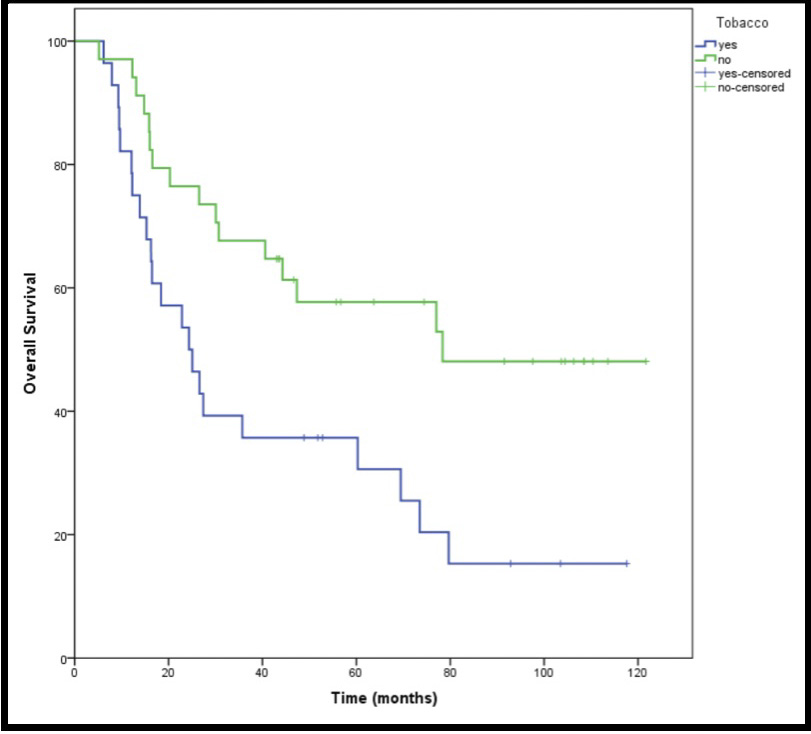
All the high-risk factors like age margin close/positive, PNI +, LVSI +, comorbidities, smoking, alcohol intake and tobacco intake were further evaluated by Cox regression multivariate analysis where tobacco intake was found to have significant association with poor DFS (p=0.018) and OS (p=0.011). The 5-year DFS for patients with history of tobacco intake was 14.4%- and 5-year OS was 35.6%. (Fig 1 C,D).
Figure Legend:
Fig 1: A: Overall survival (OS) curve, B: Disease free survival (DFS) curve, C: Overall survival for habit like chewing pan, gutka, or tobacco intake (no history vs. history present: 57.6% vs. 35.6%; p = 0.011), D: Disease free survival for habit like chewing pan, gutka, or tobacco intake (no history vs. history present: 55.41% vs. 14.4%; p = 0.018).
4. Discussion and Conclusion
In our cohort of 62 patients with oral cavity squamous cell carcinoma (OCSCC) with major ENE (>2mm), we performed an in-depth analysis of treatment failure patterns, other prognostic factors, and survival outcomes.
All patients in our cohort received adjuvant chemoradiation post-surgery, reflecting the established benefit of CCT in cases with ENE, as supported by landmark trials EORTC-22931 and RTOG-9501 (9-12). Despite this, ENE continued to have a significant impact on DFS and overall survival emphasizing its poor prognostic impact. This finding aligns with previous retrospective studies, which have identified ENE as a key predictor of overall survival in OCSCC (13-15).
In their prospective randomized study, Laskar et al16 demonstrated a survival benefit for a subset of patients with a combination of high-risk features (advanced N-stage, T-stage, and extranodal extension positive) when treated with chemoradiation, the 5-year actuarial DFS estimates being 44% and OS around 38%.
The extent of ENE (major i.e. >2mm) is further identified as poor prognostic marker. According to a recent study by Joshi et al17, the 2-year survival rate when compared for microscopic ENE (≤2 mm) vs macroscopic ENE (>2 mm) was 72.6% and 0% respectively. They also reported the distal failure rate for major ENE group as 44.83%. Another study by Kolarski et al18 found that patients with major ENE who received chemoradiation had overall survival of 44% and John et al19 also reported that patients with major ENE had marginally lower 5-year local control of 59%, lower distant control of around 58% and DFS of 13%.
In their paper Best et al20 reported 5-year OS for major ENE as 20.7% and 5-year DFS as 18.1%. The authors secondarily found that patients with multiple ENE-positive nodes had worse OS (P = .001) and DFS (P = .001) than subjects with only 1 ENE-positive node. This was also consolidated in the paper by Agarwal et al21 who found that ENE grade 3 through 4 (i.e. major ENE) and ENE in more than two lymph nodes conferred poor prognosis (3-year OS: 18%; P = 0.000).
We also found the 5-year DFS and OS rate for the entire study population as 38.68% and 47%, respectively, similar to these studies and notably around 63% patients in our cohort also had ENE positive in 2 or more nodes. Out of the 62 patients studied, 36 (58%) experienced treatment failures, which comprised predominantly of distant failures. We found that 5/36 patients (13.8%) experienced both in-field recurrences and distant metastasis while widespread distant only metastatic recurrence was observed in 16/36 patients (44.4%).
Alcohol, smoking and tobacco are well-documented prognostic factors for head and neck oral cavity cancer22. In our Indian population, the adverse impact of pan/gutka/tobacco intake on DFS was particularly notable and showed a significant negative impact on DFS (p=0.018) and OS (p=0.011) in multivariate analysis.
In conclusion, distant failure remains the predominant cause of treatment failure in major ENE positive OCSCC and combined with the history of tobacco intake, it further led to poor survival outcomes. Despite the modest survival outcomes, there is potential to improve prognosis further. This single-institution study, with uniform treatment protocol, helps minimize confounding effects from variations in the quality of locoregional treatment and highlights the biological aggressiveness of the disease. This also provides an addition to the published real-world data on ENE, which is needed to strengthen the research work.
Abbreviations
AJCC – American Joint Committee on Cancer
CRT – Chemoradiotherapy
CT – Computed Tomography
CTV – Clinical Target Volume
DFS – Disease-Free Survival
ENE – Extranodal Extension
ECOG – Eastern Cooperative Oncology Group
Gy – Gray
MRI – Magnetic Resonance Imaging
OCSCC – Oral Cavity Squamous Cell Carcinoma
OS – Overall Survival
PET – Positron Emission Tomography
PNI – Perineural Invasion
PTV – Planning Target Volume
RT – Radiotherapy
VMAT – Volumetric Modulated Arc Therapy
LVSI – Lymphovascular Space Invasion
Statements
Conflict of Interest: None
Funding: None
Acknowledgement: None
References:
- Willis R. Epidermoid carcinoma of the head and neck, with special reference to metastasis. J Pathol Bacteriol.1930;33(3):501–526.
- Schuller DE, McGuirt WF, McCabe BF, Young D. The prognostic significance of metastatic cervical lymph nodes. Laryngoscope. 1980;90(4):557–570.
- Mermod M, Tolstonog G, Simon C, Monnier Y. Extracapsular spread in head and neck squamous cell carcinoma: a systematic review and meta-analysis. Oral Oncol. 2016;62:60–71. doi:10.1016/j.oraloncology.2016.10.003
- Bhattacharya P, Mukherjee R. Lymph node extracapsular extension as a marker of aggressive phenotype: classification, prognosis, and associated molecular biomarkers. Eur J Surg Oncol. 2021;47(4):721–731.
- de Almeida JR, Yao CMKL, Ziai H, et al. Postoperative wound infections, neutrophil-to-lymphocyte ratio, and cancer recurrence in patients with oral cavity cancer undergoing surgical resection. Oral Oncol. 2019;97:23–30. doi:10.1016/j.oraloncology.2019.07.023
- Amin MB, Edge SB, Greene FL, et al., eds. AJCC Cancer Staging Manual. 8th ed. Springer; 2017.
- de Almeida JR, Su JS, Kolarski MM, et al. Development and validation of a novel TNM staging N-classification of oral cavity squamous cell carcinoma. Cancer. 2023;130(3):410–420. doi:10.1002/cncr.35020
- Wreesmann VB, Katabi N, Palmer FL, et al. Influence of extracapsular nodal spread extent on prognosis of oral squamous cell carcinoma. Head Neck. 2016;38(Suppl 1):E1192–E1199. doi:10.1002/hed.24190
- Bernier J, Cooper JS, Pajak TF, et al. Defining risk levels in locally advanced head and neck cancers: a comparative analysis of concurrent postoperative radiation plus chemotherapy trials of the EORTC (22931) and RTOG (9501). Head Neck. 2005;27(10):843–850. doi:10.1002/hed.20279
- Bernier J, Ozsahin M, Lefèbvre JL, Maingon P, Cognetti F, van Glabbeke M. Postoperative irradiation with or without concomitant chemotherapy for locally advanced head and neck cancer. N Engl J Med. 2004;350(19):1945–1952.
- Cooper JS, Pajak TF, Forastiere AA, et al. Postoperative concurrent radiotherapy and chemotherapy for high-risk squamous-cell carcinoma of the head and neck. N Engl J Med. 2004;350(19):1937–1944. doi:10.1056/NEJMoa032646
- Cooper JS, Zhang Q, Pajak TF, et al. Long-term follow-up of the RTOG 9501/Intergroup phase III trial: postoperative concurrent radiation therapy and chemotherapy in high-risk squamous cell carcinoma of the head and neck. Int J Radiat Oncol Biol Phys. 2012;84(5):1198–1205. doi:10.1016/j.ijrobp.2012.05.008
- Wreesmann VB, Katabi N, Palmer FL, et al. Influence of extracapsular nodal spread extent on prognosis of oral squamous cell carcinoma. Head Neck. 2016;38(Suppl 1):E1192–E1199. doi:10.1002/hed.24190
- Montoro JR, Hicz HA, de Souza L, et al. Prognostic factors in squamous cell carcinoma of the oral cavity. Braz J Otorhinolaryngol. 2008;74:861–866. doi:10.1016/S1808-8694(15)30146-4
- Mamic M, Lucijanic M, Manojlovic L, et al. Prognostic significance of extranodal extension in oral cavity squamous cell carcinoma with occult neck metastases. Int J Oral Maxillofac Surg. 2021;50:309–315. doi:10.1016/j.ijom.2020.07.006
- Ghosh-Laskar S, Chaukar D, Deshpande M, et al. Oral Cavity Adjuvant Therapy (OCAT): A phase III randomized controlled trial of surgery followed by conventional radiotherapy versus concurrent chemoradiotherapy versus accelerated radiotherapy in locally advanced resectable oral cavity squamous cell carcinoma. Eur J Cancer. 2023. doi:10.1016/j.ejca.2022.12.016
- Joshi K, Agarwal M, et al. Macroscopic extranodal extension in oral squamous cell carcinoma: a subgroup with poor survival. Laryngoscope. 2023;133(3):588–593. doi:10.1002/lary.30158
- Kolarski M, et al. Effectiveness of adjuvant chemoradiotherapy for oral cavity squamous cell carcinoma with minor and major extranodal extension: a multi-institutional consortium study. J Clin Oncol. 2022;40(16_suppl):6010. doi:10.1200/JCO.2022.40.16_suppl.6010
- de Almeida JR, Truong T, et al. Treatment implications of postoperative chemoradiotherapy for squamous cell carcinoma of the oral cavity with minor and major extranodal extension. Oral Oncol. 2020;110:104845. doi:10.1016/j.oraloncology.2020.104845
- Best DL, Jazayeri HE, et al. Extent of extranodal extension in oral cavity squamous cell carcinoma is not independently associated with overall or disease-free survival at a 2.0-mm threshold. J Oral Maxillofac Surg.2022;80(12):1978–1988. doi:10.1016/j.joms.2022.08.019
- Agarwal JP, Kane S, Ghosh-Laskar S, et al. Extranodal extension in resected oral cavity squamous cell carcinoma: more to it than meets the eye. Laryngoscope. 2019;129(5):1130–1136. doi:10.1002/lary.27508
- Leoncini E, Vukovic V, et al. Clinical features and prognostic factors in patients with head and neck cancer: results from a multicentric study. Cancer Epidemiol. 2015;39(3):367–374.