

Author(s) :
Mehdi Alem1, Maryam Msakem1, Mounir Belcadi Abbassi1, Diango Keita1, Lamiae Amaadour1, Karima Oualla1, Zineb Benbrahim1, Samia Arifi1, Nawfel Mellas1
1Department of Medical Oncology, Hassan II University Hospital, Fez 30000, Morocco
Corresponding author: Mehdi Alem, Email: mehdi.alem@usmba.ac.ma
Publication History: Received - 28 February 2026, Revised - , Accepted - 30 September 2026, Published Online - 06 October 2026.
Copyright: © 2026 The author(s). Published by Casa Cărții de Știință.
User License: Creative Commons Attribution – NonCommercial (CC BY-NC)
 Share
Share
Highlights
- FOLFIRINOX, gemcitabine plus nab-paclitaxel and NALIRIFOX remain the validated first-line options for advanced PDAC in patients with good performance status.
- PANOVA-3 is the first phase III trial to show an overall survival benefit in locally advanced PDAC, with TTFields added to chemotherapy (16.2 vs 14.2 months).
- Daraxonrasib, a RAS(ON) multi-selective inhibitor, nearly doubled overall survival versus chemotherapy in previously treated metastatic PDAC (13.2 vs 6.7 months).
- Early molecular profiling (BRCA, KRAS, MSI/MMR, NRG1) is essential to guide treatment, though access to newer therapies remains limited outside high-resource settings.
Abstract
Background. Pancreatic ductal adenocarcinoma (PDAC) is the third leading cause of cancer-related death in Western countries and carries a poor 5-year survival rate of less than 10%. With only 10–20% of patients eligible for curative surgery, systemic chemotherapy remains the cornerstone of treatment for the majority. Significant therapeutic advances have been achieved over the past decade, with new regimens, novel biological agents, and innovative physical approaches now reshaping the therapeutic landscape.
Objective. This narrative review summarizes the current evidence base for the systemic treatment of locally advanced and metastatic PDAC, with a focus on clinically significant data published between 2018 and 2026.
Key results. FOLFIRINOX, gemcitabine plus nab-paclitaxel, and NALIRIFOX remain the three validated first-line regimens for patients with good performance status (PS). The NAPOLI-3 trial established NALIRIFOX as a third first-line option with a superior median overall survival (OS 11.1 vs 9.2 months). The phase III PANOVA-3 trial demonstrated, for the first time, a significant overall survival benefit from adding tumor-treating fields (TTFields) to chemotherapy in locally advanced disease (median OS 16.2 vs 14.2 months), leading to FDA approval. Second-line treatment choice depends on the first-line regimen received: gemcitabine plus nab-paclitaxel is preferred after FOLFIRINOX or NALIRIFOX, while fluorouracil-based regimens (FOLFOX, liposomal irinotecan plus 5-FU/LV) are preferred after gemcitabine-based first-line therapy, both providing superior outcomes to gemcitabine monotherapy. For molecularly selected patients, olaparib is indicated as maintenance in germline BRCA-mutated disease, and daraxonrasib — a first-in-class RAS(ON) multi-selective inhibitor — has since demonstrated a significant overall survival benefit over chemotherapy in the phase III RASolute 302 trial in previously treated metastatic PDAC (median OS 13.2 vs 6.7 months; HR 0.40) and received FDA approval in August 2026 on this basis.
Conclusions. The PDAC treatment landscape is evolving rapidly. Patient selection based on performance status, comorbidities, and molecular profiling is paramount. The confirmed phase III survival benefit of daraxonrasib, demonstrated specifically in previously treated metastatic PDAC, represents an early proof-of-concept that targeted therapy can meaningfully change outcomes in this molecularly defined population, with first line and adjuvant trials now underway to define its broader role.
Introduction
Pancreatic ductal adenocarcinoma (PDAC) is the seventh leading cause of cancer-related death worldwide and the third in Western countries, accounting for over 430,000 deaths annually (1). The overall 5-year survival rate remains below 10%, largely because most patients present with locally advanced or metastatic disease at diagnosis, when curative surgical resection is no longer feasible (2). In approximately 40% of patients, locoregional extension precludes surgery, while a further 40–50% present with overt metastatic disease (3).
Systemic chemotherapy is therefore the primary treatment modality for the vast majority. Progress has been slow: from gemcitabine monotherapy, introduced as the standard of care in 1997, to FOLFIRINOX in 2011 and NALIRIFOX more recently, each step forward has offered only modest survival gains measured in months rather than years. Yet 2025 brought two notable advances: the first phase III trial to demonstrate an overall survival benefit specifically in locally advanced PDAC (PANOVA-3, TTFields), and breakthrough therapy designation for daraxonrasib — the first broadly applicable KRAS-targeted agent — in previously treated PDAC. This review synthesizes the current evidence for each stage of PDAC systemic treatment and outlines the most promising emerging strategies.
Literature Search Strategy. A systematic search of PubMed/MEDLINE, EMBASE, and the Cochrane Library was initially performed in January 2026 and subsequently updated through August 2026, using the following search terms: “pancreatic cancer” OR “pancreatic ductal adenocarcinoma” combined with “chemotherapy”, “targeted therapy”, “immunotherapy”, “FOLFIRINOX”, “nab-paclitaxel”, “NALIRIFOX”, “tumor-treating fields”, “KRAS”, “BRCA”, “NRG1”, “olaparib”, and “daraxonrasib”. Conference proceedings from ASCO, ESMO, and ASCO GI (2018–2026) were also reviewed. Included studies were randomized controlled trials, prospective phase II/III trials, large retrospective series (n ≥ 100), and systematic reviews with meta-analyses published between January 2018 and August 2026, reporting on systemic treatment of locally advanced or metastatic PDAC. Case reports, editorials, and studies in resectable disease (unless reporting neoadjuvant outcomes) were excluded. No language restriction was applied.
1. First-Line Systemic Treatment of Advanced PDAC:
1.1 FOLFIRINOX:
The PRODIGE 4/ACCORD11 phase III trial, enrolling 342 patients with metastatic PDAC and ECOG PS 0–1, established FOLFIRINOX (oxaliplatin 85 mg/m², irinotecan 180 mg/m², leucovorin 400 mg/m², 5-FU 400 mg/m² bolus + 2400 mg/m² 46h infusion, q14d) as a superior alternative to gemcitabine monotherapy: median overall survival (OS) 11.1 vs 6.8 months and median progression-free survival (PFS) 6.4 vs 3.3 months (1). Hematological toxicity was substantial — grade 3/4 neutropenia occurred in 46% of patients — and the regimen requires a port, regular monitoring, and a preserved performance status. A modified version omitting the 5-FU bolus (mFOLFIRINOX) is now most commonly employed in clinical practice to reduce toxicity while preserving efficacy.
FOLFIRINOX also demonstrated superiority over gemcitabine-based regimens as neoadjuvant/induction therapy in locally advanced (LAPC) and borderline resectable PDAC: a meta-analysis of 2930 patients from 23 studies showed a median OS of 17.1 months with FOLFIRINOX versus 12.5 months with gemcitabine-based regimens (4).
1.2 Gemcitabine plus Nab-paclitaxel:
The MPACT phase III trial (n = 861) established gemcitabine plus nab-paclitaxel (125 mg/m² + 1000 mg/m², D1-D8-D15 q28d) as an effective alternative to gemcitabine alone: median OS 8.5 vs 6.7 months (2). This regimen is particularly suited to patients with a worse PS or contraindications to irinotecan (e.g., Gilbert syndrome, significant hyperbilirubinemia), and is the preferred first-line doublet in patients unable to tolerate a triplet.
A key clinical question — which first-line triplet regimen is superior? — was directly addressed by the PASS-01 phase II trial (n = 160), which randomized patients head-to-head between mFOLFIRINOX and gemcitabine plus nab-paclitaxel (GN). Contrary to earlier indirect comparisons suggesting FOLFIRINOX superiority, PASS-01 showed comparable PFS (4.0 vs 5.3 months; not statistically significant) and a significantly inferior median OS in the mFOLFIRINOX arm (8.5 vs 9.7 months; HR 1.57; p=0.02) (20). These unexpected findings support gemcitabine plus nab-paclitaxel as a reasonable, and possibly preferable, first-line option — particularly in patients where gastrointestinal toxicity is a concern or where tumor molecular subtype may favor this regimen.
1.3 NALIRIFOX (NAPOLI-3):
The phase III NAPOLI-3 trial (n = 770) compared NALIRIFOX — a novel regimen substituting conventional irinotecan with liposomal irinotecan at a reduced dose (50 mg/m²), combined with oxaliplatin 60 mg/m², leucovorin 400 mg/m², and 5-FU 2400 mg/m², q14d — with gemcitabine plus nab-paclitaxel in treatment-naïve patients with metastatic PDAC (3). NALIRIFOX achieved a superior median OS (11.1 vs 9.2 months; HR 0.83; p=0.04) and PFS (7.4 vs 5.6 months; HR 0.69; p<0.0001). Both arms exhibited significant toxicity (grade ≥3 adverse events in ~90%), primarily diarrhea, hypokalemia, and neutropenia with NALIRIFOX. Current ESMO guidelines now place NALIRIFOX alongside FOLFIRINOX as a preferred first-line triplet option for eligible patients. Relative cost and geographic availability remain practical limiting factors.
A Bayesian network meta-analysis comparing these three first-line strategies confirmed that both FOLFIRINOX and NALIRIFOX offer a modest OS advantage over gemcitabine plus nab-paclitaxel, with pooled median OS estimates favoring the triplet regimens (approximately 10.4 months), while noting that real-world toxicity management with the doublet has improved substantially since the original MPACT trial (21).
1.4 Gemcitabine Monotherapy:
In patients with poor performance status (ECOG PS 2–3) or significant comorbidities precluding combination therapy, gemcitabine monotherapy at 1000 mg/m² (7 weeks on/1 off then D1-D8-D15 q28d) remains the standard of care. The landmark 1997 trial by Burris et al. demonstrated a modest but significant improvement in median OS compared to 5-fluorouracil (5.6 vs 4.4 months) alongside improvements in clinical benefit response — a composite endpoint including pain, performance status, and weight (6). The well-documented tolerability of gemcitabine, with minimal quality-of-life impairment, makes it a rational choice in fragile patients for whom the priority is preserved function over maximum efficacy.
1.5 Tumor-Treating Fields in Locally Advanced PDAC: A Breakthrough:
One of the most significant results of 2025 was the PANOVA-3 phase III trial, which evaluated the addition of tumor-Treating Fields (TTFields) — a non-invasive device-based therapy delivering alternating electric fields at 150 kHz via abdominal arrays — to gemcitabine plus nab-paclitaxel chemotherapy in patients with locally advanced, unresectable LAPC (5). Among 571 randomized patients, the addition of TTFields significantly improved median OS (16.2 vs 14.2 months; HR 0.82; p=0.03) and a significant improvement in the 1-year OS rate (68.1% vs 60.2%; p=0.03). Pain-free survival and distant PFS were also significantly improved, without exacerbation of systemic chemotherapy toxicity. The only additional adverse event attributable to TTFields was localized, predominantly low-grade skin irritation at array sites.
Critically, PANOVA-3 is the first and only phase III trial specifically in unresectable LAPC to demonstrate a statistically significant OS benefit — a milestone in a subgroup historically lacking dedicated randomized data. The FDA granted approval to Optune Pax (NovoTTF-200T system) for LAPC in February 2026.
Limitations and Practical Considerations for TTFields. While the PANOVA-3 results are clinically significant, several limitations warrant consideration. The absolute OS improvement was modest (2.0 months), and the PFS benefit did not reach statistical significance (10.6 vs 9.3 months; p not reported as significant). The TTFields device requires continuous wearing (recommended ≥ 18 hours/day) via abdominal transducer arrays, which imposes a substantial compliance burden and may impair quality of life for some patients. Skin irritation, predominantly low-grade, was the principal device-related adverse event but may be clinically relevant in the context of prolonged therapy. The device cost is substantial, and reimbursement remains limited outside the United States; access is therefore currently restricted to high-resource settings. Patients with significant ascites, abdominal skin disorders, or implanted electronic devices were excluded from the trial, further limiting the eligible population in routine practice. These factors must be weighed against the survival benefit when considering TTFields for individual patients.
Table 1. Summary of first-line systemic treatment options for advanced PDAC.
| Regimen | Study / Phase | n | Median OS (months) | Median PFS (months) | Key toxicities |
|---|---|---|---|---|---|
| FOLFIRINOX | PRODIGE 4/ACCORD11 (1) (Phase III) | 342 | 11.1 vs 6.8 (Gem) | 6.4 vs 3.3 | Neutropenia 46%, diarrhea, neuropathy |
| Gemcitabine + nab-paclitaxel | MPACT (2) (Phase III) | 861 | 8.5 vs 6.7 (Gem) | 5.5 vs 3.7 | Neutropenia, neuropathy, fatigue |
| NALIRIFOX | NAPOLI-3 (3) (Phase III) | 770 | 11.1 vs 9.2 (GN) | 7.4 vs 5.6 | Diarrhea, hypokalemia, neutropenia |
| mFOLFIRINOX vs GN (head-to-head) | PASS-01 (20) (Phase II) | 160 | 8.5 vs 9.7 (GN superior) | 4.0 vs 5.3 | Higher hospitalizations with mFOLFIRINOX |
| TTFields + Gem/nab-P | PANOVA-3 (5) (Phase III) | 571 (LAPC) | 16.2 vs 14.2 (Gem/nab-P) | 10.6 vs 9.3 (NS) | Skin reactions (TTFields, low-grade) |
| Gemcitabine monotherapy | Burris et al., 1997 (6) (Phase III) | 126 | 5.6 vs 4.4 (5-FU) | NR | Well tolerated, reserve for PS 2–3 |
PDAC, pancreatic ductal adenocarcinoma; Gem, gemcitabine; LAPC, locally advanced pancreatic cancer; OS, overall survival; PFS, progression-free survival; NS, not significant; TTFields, tumor-treating fields; NR, not reported.
2. Second-Line Systemic Treatment:
2.1 After FOLFIRINOX:
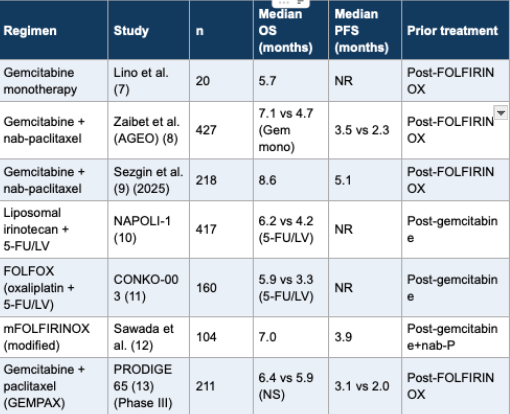
Following progression on FOLFIRINOX, gemcitabine-based regimens form the basis of second-line therapy. Gemcitabine monotherapy, historically used in this setting, achieves a median OS of approximately 5.7 months in retrospective data (7). The combination of gemcitabine plus nab-paclitaxel has demonstrated superior outcomes over gemcitabine alone in the post-FOLFIRINOX setting across several studies. A real-world AGEO study (n = 427) reported a median OS of 7.1 vs 4.7 months and PFS of 3.5 vs 2.3 months in favor of the doublet (8). These findings were corroborated by a 2025 multicenter Turkish series (n = 218), which reported median PFS 5.1 months and median OS 8.6 months (9).
The phase III PRODIGE 65/GEMPAX trial evaluated gemcitabine plus conventional paclitaxel vs gemcitabine alone after FOLFIRINOX failure (n = 211), reporting improved PFS (3.1 vs 2.0 months; HR 0.64; p=0.0067) and objective response rate (17.1% vs 4.2%; p=0.008), but no statistically significant OS benefit (6.4 vs 5.9 months; HR 0.87; p=0.41) (13). This neutral OS result limits the routine use of this combination and reinforces the preference for nab-paclitaxel over conventional paclitaxel in this context.
2.2 After Gemcitabine-Based Therapy:
For patients progressing after gemcitabine-based treatment, fluorouracil-based regimens are the standard of care. The randomized CONKO-003 trial (n = 160) demonstrated that the addition of oxaliplatin to 5-FU/LV (FOLFOX4-like regimen) extends median OS from 3.3 to 5.9 months compared to 5-FU/LV alone (11). Oxaliplatin-containing regimens (FOLFOX or OFF) are therefore the preferred second-line choice in post-gemcitabine patients with preserved performance status (Karnofsky ≥70%). The contradictory results of the PANCREOX trial (inferior OS with FOLFOX6 vs FU/LV) are explained by the higher fluorouracil doses used, highlighting the importance of dose selection when using oxaliplatin-based regimens.
Liposomal irinotecan (nal-IRI) combined with 5-FU/LV is the second pivotal option in this setting, validated by the phase III NAPOLI-1 trial (n = 417): the triplet achieved a median OS of 6.2 months versus 4.2 months for 5-FU/LV alone (HR 0.67; p=0.012) (10). Nal-IRI is approved in this indication by FDA and EMA and is particularly suited to patients who have not previously received irinotecan.
Modified FOLFIRINOX as second-line therapy after progression on gemcitabine plus nab-paclitaxel has also been evaluated in smaller series, with Sawada et al. reporting median OS 7.0 months and PFS 3.9 months in 104 patients (12). These results support its use in selected patients with maintained PS.
Table 2. Second-line systemic treatment options in advanced PDAC.
| Regimen | Study | n | Median OS (months) | Median PFS (months) | Prior treatment |
|---|---|---|---|---|---|
| Gemcitabine monotherapy | Lino et al. (7) | 20 | 5.7 | NR | Post-FOLFIRINOX |
| Gemcitabine + nab-paclitaxel | Zaibet et al. (AGEO) (8) | 427 | 7.1 vs 4.7 (Gem mono) | 3.5 vs 2.3 | Post-FOLFIRINOX |
| Gemcitabine + nab-paclitaxel | Sezgin et al. (9) (2025) | 218 | 8.6 | 5.1 | Post-FOLFIRINOX |
| Liposomal irinotecan + 5-FU/LV | NAPOLI-1 (10) | 417 | 6.2 vs 4.2 (5-FU/LV) | NR | Post-gemcitabine |
| FOLFOX (oxaliplatin + 5-FU/LV) | CONKO-003 (11) | 160 | 5.9 vs 3.3 (5-FU/LV) | NR | Post-gemcitabine |
| mFOLFIRINOX (modified) | Sawada et al. (12) | 104 | 7.0 | 3.9 | Post-gemcitabine+nab-P |
| Gemcitabine + paclitaxel (GEMPAX) | PRODIGE 65 (13) (Phase III) | 211 | 6.4 vs 5.9 (NS) | 3.1 vs 2.0 | Post-FOLFIRINOX |
5-FU, 5-fluorouracil; LV, leucovorin; OS, overall survival; PFS, progression-free survival; NS, not significant; Gem, gemcitabine; nab-P, nab-paclitaxel.
3. Molecularly Targeted Therapy and Immunotherapy:
3.1 PARP Inhibition: Olaparib in gBRCA-Mutated PDAC:
Germline BRCA1 or BRCA2 mutations are identified in approximately 5–7% of PDAC patients and confer increased sensitivity to platinum-based chemotherapy and PARP inhibitors. The phase III POLO trial (n = 154) randomized patients with germline BRCA-mutated metastatic PDAC who had not progressed after at least 16 weeks of first-line platinum-based therapy to maintenance olaparib (300 mg twice daily) vs placebo (14). Olaparib significantly extended PFS (7.4 vs 3.8 months; HR 0.53; p<0.001) but did not improve OS (18.9 vs 18.1 months; HR 0.83; p=0.34). Despite the absence of an OS benefit — partly attributable to crossover and subsequent therapy use — olaparib is approved by FDA and EMA as maintenance therapy in this molecularly defined subgroup, allowing chemotherapy-free interval while maintaining disease control.
3.2 Immunotherapy: The Narrow MSI-H Window:
Microsatellite instability-high (MSI-H) or mismatch repair-deficient (dMMR) tumors represent fewer than 1% of PDAC cases but are characterized by exceptionally high tumor mutational burden and sensitivity to immune checkpoint inhibitors. The KEYNOTE-158 basket trial evaluated pembrolizumab in patients with MSI-H/dMMR solid tumors across 10 tumor types (15). In the 23-patient PDAC subgroup, an objective response rate of 22% was observed, with two complete responses, and the median OS was 4 months. Despite the modest PDAC-specific efficacy, tumor-agnostic approval of pembrolizumab for MSI-H cancers covers PDAC. Universal testing for MSI/MMR at diagnosis — or at first progression — is recommended to identify the rare patient likely to benefit from immunotherapy.
Beyond MSI-H, broad immunotherapy strategies (anti-PD-1/PD-L1 monotherapy or combinations) have consistently failed to demonstrate meaningful benefit in unselected PDAC populations, due to the highly immunosuppressive tumor microenvironment rich in cancer-associated fibroblasts and immunosuppressive myeloid cells. Ongoing research into cancer vaccines, CAR-T cells, and stroma-targeting combination strategies represents a promising but still experimental frontier.
3.3 KRAS-Targeted Therapy: The Daraxonrasib Breakthrough:
KRAS mutations are present in more than 90% of PDAC cases, making KRAS the principal oncogenic driver of this disease. For decades, KRAS was considered undruggable. This changed with the development of covalent KRAS G12C inhibitors (sotorasib, adagrasib), though KRAS G12C represents only 1–3% of PDAC mutations. In the phase I/II CodeBreaK 100 trial (n = 38 PDAC), sotorasib achieved an ORR of 21% and a median OS of 6.9 months in previously treated patients (16) — meaningful activity but limited in scope.
Daraxonrasib (RMC-6236), a first-in-class oral, direct RAS(ON) multi-selective inhibitor that suppresses the active, GTP-bound form of RAS by blocking its interaction with downstream effectors via a tri-complex mechanism. Unlike covalent G12C inhibitors, daraxonrasib targets a broad spectrum of oncogenic KRAS mutations — G12X, G13X, and Q61X — covering more than 85% of all PDAC cases.
Updated data from the phase 1 RMC-6236-001 trial, presented at the 2025 ASCO GI Symposium, reported outcomes at the phase III dose of 300 mg daily: among 59 evaluable patients, the ORR was 36% in the KRAS G12X subgroup and 27% in the broader RAS-mutant population, with a median PFS of 8.8 months (KRAS G12X) and 8.5 months (all RAS-mutant), and a 6-month OS rate of 100% and 97%, respectively (17). The safety profile was manageable, with predominantly low-grade rash and gastrointestinal toxicities.
Based on these data, the FDA granted Breakthrough Therapy Designation to daraxonrasib in June 2025, followed by Orphan Drug Designation in October 2025. These findings have since been confirmed in the pivotal phase III RASolute 302 trial (NCT06625320), which randomized 500 patients with previously treated metastatic PDAC 1:1 to daraxonrasib 300 mg once daily or investigator’s choice of standard second-line chemotherapy. At the data cutoff (10 February 2026; median follow-up 8.5 months), the trial met its dual primary endpoints of OS and PFS in the RAS G12-mutant population, as well as key secondary endpoints in the overall intention-to-treat population, which included patients without an identified tumor RAS mutation. Median OS was 13.2 months with daraxonrasib versus 6.7 months with chemotherapy (HR 0.40; p<0.0001) in the overall population, with a concordant PFS benefit and a manageable safety profile with no new safety signals (18). Based on these results, the FDA approved daraxonrasib (RASONQUE) on 26 August 2026 for adults with metastatic PDAC who have received at least one prior systemic therapy or are not candidates for multiagent systemic therapy, making it the first approved RAS-targeted therapy in this disease. Two further phase III trials remain ongoing: RASolute 303 (first-line PDAC, including a combination arm with chemotherapy), and RASolute 304 (adjuvant setting). In first-line treatment-naïve patients, preliminary data at 300 mg showed an ORR of 47% (monotherapy), with disease control rates exceeding 89%.
3.4 NRG1 Fusion: Zenocutuzumab:
NRG1 gene fusions, present in approximately 1% of PDAC cases, activate HER2/HER3 signaling through neuregulin-1 binding. Zenocutuzumab, a bispecific IgG1 antibody targeting HER2 and HER3, blocks the interaction of NRG1 with HER3 and disrupts the PI3K/AKT/mTOR pathway. In the phase II eNRGy basket trial (n = 36 PDAC), zenocutuzumab achieved an ORR of 42% in the pancreatic subgroup, with a median duration of response of 11.1 months (19). The FDA granted accelerated approval for zenocutuzumab in NRG1 fusion-positive solid tumors in 2024. Although the eligible population is small, universal RNA fusion testing at diagnosis or first progression is warranted to identify candidates for this highly active targeted therapy, particularly in patients with no smoking history and wild-type KRAS.
Table 3. Targeted agents and immunotherapy in advanced PDAC: key results and current status.
| Agent | Target / Mechanism | Study / Phase | n | Key result | Status (Aug 2026) |
|---|---|---|---|---|---|
| Olaparib | PARP inhibitor (BRCA1/2) | POLO (14) (Phase III) | 154 | PFS 7.4 vs 3.8 months; OS no difference | Approved: maintenance after platinum ≥16 weeks, gBRCA-mutated |
| Pembrolizumab | anti-PD-1 (MSI-H/dMMR) | KEYNOTE-158 (15) (Phase II) | 23 (PDAC subgroup) | ORR 22% in PDAC; PFS 2.1 months | Approved for MSI-H regardless of tumor type |
| Sotorasib | KRAS G12C inhibitor | CodeBreaK 100 (16) (Phase I/II) | 38 PDAC | ORR 21%; PFS 4 months; OS 6.9 months | Limited use: KRAS G12C ~1-3% of PDAC |
| Daraxonrasib (RMC-6236) | RAS(ON) multi-selective inhibitor (G12X/G13X/Q61X) | RMC-6236-001 (17) (Phase I) → RASolute 302 (18) (Phase III) | 59 (second-line PDAC, 300 mg) | Phase I: ORR 36% (G12X); Phase III RASolute 302: OS 13.2 vs 6.7 mo (HR 0.40) | FDA Breakthrough Therapy Jun 2025; positive phase III RASolute 302 (May 2026); FDA approved 26 Aug 2026 |
| Zenocutuzumab | Bispecific anti-HER2/HER3 (NRG1 fusion) | eNRGy trial (19) (Phase II) | 36 PDAC | ORR 42% in PDAC; mDOR 11.1 months | Approved by FDA (2024) for NRG1 fusion-positive solid tumors (~1% PDAC) |
| TTFields (Optune Pax) | Alternating electric fields (150 kHz) | PANOVA-3 (5) (Phase III) | 571 (LAPC) | OS 16.2 vs 14.2 months | FDA approved (Feb 2026) for unresectable LAPC + Gem/nab-P |
PDAC, pancreatic ductal adenocarcinoma; PARP, poly-ADP ribose polymerase; PFS, progression-free survival; OS, overall survival; ORR, objective response rate; mDOR, median duration of response; LAPC, locally advanced pancreatic cancer; TTFields, tumor-treating fields; gBRCA, germline BRCA; MSI-H, microsatellite instability-high; dMMR, mismatch repair-deficient; NS, not significant.
4. Treatment Selection and Algorithmic Approach:
The selection of the optimal systemic regimen depends on a careful assessment of performance status, comorbidities, molecular profile, and the sequence of prior treatments. For patients with ECOG PS 0–1, the three first-line options — FOLFIRINOX, NALIRIFOX, and gemcitabine plus nab-paclitaxel — are each supported by phase III data. In the absence of a validated biomarker to guide the choice between triplet and doublet regimens prospectively, clinical factors and individual toxicity profiles should guide the decision. For patients with unresectable LAPC and ECOG PS 0–2, the addition of TTFields to standard chemotherapy should now be considered where access permits, based on the PANOVA-3 survival benefit.
Germline and somatic molecular profiling — including BRCA1/BRCA2, KRAS G12X, MSI/MMR, NRG1 fusions, and NTRK fusions — should be performed as early as possible, ideally at diagnosis, so that results are available to guide treatment sequencing. This will enable maintenance olaparib in BRCA-mutated patients, immunotherapy in MSI-H cases, and enrolment in trials evaluating daraxonrasib and other emerging agents. In the second-line setting, the choice is largely determined by first-line treatment: gemcitabine-based regimens (gemcitabine plus nab-paclitaxel) after progression on FOLFIRINOX or NALIRIFOX, and fluorouracil-based regimens (FOLFOX, nal-IRI+5-FU/LV) after gemcitabine-based first-line therapy.
Biomarker-to-Treatment Decision Algorithm. To translate molecular profiling into clinical decisions, the following stepwise approach is proposed. At diagnosis, all patients with locally advanced or metastatic PDAC should undergo: (1) germline testing for BRCA1/BRCA2 mutations, to identify candidates for first-line platinum-based regimens and subsequent olaparib maintenance; (2) somatic NGS panel including KRAS mutation subtype characterization, to assess eligibility for daraxonrasib or investigational KRAS-directed trials; (3) MMR/MSI testing by immunohistochemistry or PCR/NGS, to identify the rare MSI-H patient eligible for pembrolizumab; and (4) RNA fusion panel including NRG1 and NTRK fusions, particularly in KRAS wild-type tumors. At first progression, any biomarker not tested at diagnosis should be obtained. Patients with KRAS G12-mutant tumors who have progressed on one prior line of therapy should now be considered for daraxonrasib as an evidence-based second-line option, based on the confirmed phase III RASolute 302 survival benefit, pending local regulatory approval and reimbursement. This algorithmic approach ensures that no actionable alteration is missed and facilitates enrolment in biomarker-selected trials, which represent the most rational path to further therapeutic progress in PDAC.
Accessibility, Cost, and Global Applicability. A critical consideration in appraising the PDAC treatment landscape is that several of the advances described in this review carry significant access limitations. NALIRIFOX, while approved in the United States and recommended in ESMO guidelines, is not yet widely reimbursed across Europe or available in low- and middle-income countries (LMICs). TTFields (Optune Pax) requires an expensive device and consumables, specialized patient training, and ongoing technical support, rendering it effectively inaccessible outside high-resource, high-income settings; the annual cost of device rental is estimated at approximately USD 150,000–200,000. Olaparib maintenance, while more widely available than TTFields, remains subject to reimbursement restrictions in many national healthcare systems and requires prior germline testing infrastructure. Following its FDA approval in August 2026 based on the RASolute 302 results, daraxonrasib is expected to become progressively available in second-line metastatic PDAC, though access outside the United States remains dependent on pending EMA and other national regulatory decisions and on reimbursement arrangements. For patients in LMICs or settings with limited oncology infrastructure, FOLFIRINOX and gemcitabine plus nab-paclitaxel remain the practical reference standards. Authors and guideline developers should explicitly acknowledge these disparities, and future trial designs should incorporate health-economic endpoints and strategies to ensure access equity.
Supportive care remains indispensable. Pain control in accordance with WHO analgesic guidelines, nutritional support, pancreatic enzyme supplementation, and psychological support are integral components of comprehensive PDAC management regardless of the systemic treatment employed.
Conclusions
The systemic treatment of advanced PDAC is undergoing a period of acceleration after decades of incremental progress. FOLFIRINOX, gemcitabine plus nab-paclitaxel, and NALIRIFOX remain the backbone of first-line therapy for patients with preserved performance status, with TTFields now adding a device-based treatment modality for locally advanced disease. Daraxonrasib — with a confirmed phase III survival benefit in the RASolute 302 trial and FDA approval in August 2026 for previously treated metastatic PDAC — represents the first broadly applicable targeted therapy in this disease given the near-ubiquity of RAS mutations and may improve outcomes for a population that has historically had few molecularly guided options beyond olaparib, pembrolizumab, and zenocutuzumab. The ongoing RASolute 303 first-line trial and RASolute 304 adjuvant trial will help determine whether daraxonrasib and other RAS(ON) inhibitors can move from second line use into earlier lines of standard of care. Until then, careful patient selection based on performance status, comorbidities, and systematic molecular profiling remains the cornerstone of optimal PDAC management, alongside equitable access to the therapies already proven to extend survival.
Abbreviations
PDAC – Pancreatic ductal adenocarcinoma
OS – Overall survival
PFS – Progression-free survival
PS – Performance status
TTFields – Tumor-treating fields
FDA – Food and Drug Administration
ECOG – Eastern Cooperative Oncology Group
5-FU – 5-fluorouracil
LV – Leucovorin
mFOLFIRINOX – Modified FOLFIRINOX
PARP – Poly-ADP ribose polymerase
gBRCA – Germline BRCA mutation
MSI-H – Microsatellite instability-high
dMMR – Mismatch repair-deficient
ORR – Objective response rate
Statements
Authors’ contributions: M.A.: Writing – original draft; writing – review and editing. M.M., M.B.A., and D.K.: Writing – review and editing. K.O.: Writing – review and editing; conceptualization. L.A., Z.B., S.A., and N.M.: Supervision and guidance. All authors reviewed and approved the final version of the manuscript.
Funding: No external funding was received for this review.
Conflict of interest: The authors declare no conflict of interest.
Declaration of AI and AI-Assisted Technologies: The authors declare that no generative AI or AI-assisted technologies were used in the writing, data analysis, or figure preparation of this manuscript.
References
- Conroy T, Desseigne F, Ychou M, et al. FOLFIRINOX versus gemcitabine for metastatic pancreatic cancer. N Engl J Med. 2011; 364(19): 1817–1825, doi: 10.1056/NEJMoa1011923.
- Von Hoff DD, Ervin T, Arena FP, et al. Increased survival in pancreatic cancer with nab-paclitaxel plus gemcitabine. N Engl J Med. 2013; 369(18): 1691–1703, doi: 10.1056/NEJMoa1304369.
- Wainberg ZA, Melisi D, Macarulla T, et al. NALIRIFOX versus nab-paclitaxel and gemcitabine in treatment-naive patients with metastatic pancreatic ductal adenocarcinoma (NAPOLI 3): a randomised, open-label, phase 3 trial. Lancet. 2023; 402(10409): 1272–1281, doi: 10.1016/S0140-6736(23)01366-1.
- Eshmuminov D, Aminjonov B, Palm RF, et al. FOLFIRINOX or gemcitabine-based chemotherapy for borderline resectable and locally advanced pancreatic cancer: a multi-institutional, patient-level, meta-analysis and systematic review. Ann Surg Oncol. 2023; 30(7): 4417–4428, doi: 10.1245/s10434-023-13353-2.
- Babiker HM, Picozzi V, Chandana SR, et al. Tumor treating fields with gemcitabine and nab-paclitaxel for locally advanced pancreatic adenocarcinoma: randomized, open-label, pivotal phase III PANOVA-3 study. J Clin Oncol. 2025; 43(21): 2350–2360, doi: 10.1200/JCO-25-00746.
- Burris HA 3rd, Moore MJ, Andersen J, et al. Improvements in survival and clinical benefit with gemcitabine as first-line therapy for patients with advanced pancreas cancer: a randomized trial. J Clin Oncol. 1997; 15(6): 2403–2413, doi: 10.1200/JCO.1997.15.6.2403.
- Lino AdR, Abrahão CM, Brandão RM, et al. Role of gemcitabine as second-line therapy after progression on FOLFIRINOX in advanced pancreatic cancer: a retrospective analysis. J Gastrointest Oncol. 2015; 6(5): 511–515, doi: 10.3978/j.issn.2078-6891.2015.041.
- Zaibet S, Hautefeuille V, Auclin E, et al. Gemcitabine + nab-paclitaxel or gemcitabine alone after FOLFIRINOX failure in patients with metastatic pancreatic adenocarcinoma: a real-world AGEO study. Br J Cancer. 2022; 126(10): 1394–1400, doi: 10.1038/s41416-022-01713-w.
- Sezgin Y, Karhan O, Aldemir MN, et al. Efficacy of gemcitabine plus nab-paclitaxel in second-line treatment of metastatic pancreatic cancer. Sci Rep. 2025; 15(1): 11675, doi: 10.1038/s41598-025-96157-6.
- Wang-Gillam A, Hubner RA, Siveke JT, et al. NAPOLI-1 phase 3 study of liposomal irinotecan in metastatic pancreatic cancer: final overall survival analysis and characteristics of long-term survivors. Eur J Cancer. 2019; 108: 78–87, doi: 10.1016/j.ejca.2018.12.007.
- Oettle H, Riess H, Stieler JM, et al. Second-line oxaliplatin, folinic acid, and fluorouracil versus folinic acid and fluorouracil alone for gemcitabine-refractory pancreatic cancer: outcomes from the CONKO-003 trial. J Clin Oncol. 2014; 32(23): 2423–2429, doi: 10.1200/JCO.2013.53.6995.
- Sawada M, Kasuga A, Mie T, et al. Modified FOLFIRINOX as a second-line therapy following gemcitabine plus nab-paclitaxel therapy in metastatic pancreatic cancer. BMC Cancer. 2020; 20(1): 449, doi: 10.1186/s12885-020-06945-8.
- De La Fouchardière C, Malka D, Cropet C, et al. Gemcitabine and paclitaxel versus gemcitabine alone after 5-fluorouracil, oxaliplatin, and irinotecan in metastatic pancreatic adenocarcinoma: a randomized phase III PRODIGE 65-UCGI 36-GEMPAX UNICANCER study. J Clin Oncol. 2024; 42(9): 1055–1066, doi: 10.1200/JCO.23.00795.
- Golan T, Hammel P, Reni M, et al. Maintenance olaparib for germline BRCA-mutated metastatic pancreatic cancer. N Engl J Med. 2019; 381(4): 317–327, doi: 10.1056/NEJMoa1903387.
- Marabelle A, Le DT, Ascierto PA, et al. Efficacy of pembrolizumab in patients with noncolorectal high microsatellite instability/mismatch repair-deficient cancer: results from the phase II KEYNOTE-158 study. J Clin Oncol. 2020; 38(1): 1–10, doi: 10.1200/JCO.19.02105.
- Strickler JH, Satake H, George TJ, et al. Sotorasib in KRAS p.G12C-mutated advanced pancreatic cancer. N Engl J Med. 2023; 388(1): 33–43, doi: 10.1056/NEJMoa2208470.
- Garrido-Laguna I, Wolpin B, Park W, et al. Safety, efficacy, and on-treatment circulating tumor DNA (ctDNA) changes from a phase 1 study of RMC-6236, a RAS(ON) multi-selective, tri-complex inhibitor, in patients with RAS mutant pancreatic ductal adenocarcinoma (PDAC). J Clin Oncol. 2025; 43(Suppl 4): 722, doi: 10.1200/JCO.2025.43.4_suppl.722.
- O’Reilly EM, Wainberg ZA, Hendifar AE, et al; RASolute 302 Trial Investigators. Daraxonrasib or chemotherapy in previously treated metastatic pancreatic cancer. N Engl J Med. 2026; 395(4): 325–337, doi: 10.1056/NEJMoa2605555.
- Schram AM, Goto K, Kim DW, et al. Efficacy of zenocutuzumab in NRG1 fusion-positive cancer. N Engl J Med. 2025; 392(6): 566–576, doi: 10.1056/NEJMoa2405008.
- Knox JJ, O’Kane G, King D, et al. PASS-01: randomized phase II trial of modified FOLFIRINOX versus gemcitabine/nab-paclitaxel and molecular correlatives for previously untreated metastatic pancreatic cancer. J Clin Oncol. 2025; 43(31): 3355–3368, doi: 10.1200/JCO-25-00436.
- Mastrantoni L, Chiaravalli M, Spring A, et al. Comparison of first-line chemotherapy regimens in unresectable locally advanced or metastatic pancreatic cancer: a systematic review and Bayesian network meta-analysis. Lancet Oncol. 2024; 25(12): 1655–1665, doi: 10.1016/S1470-2045(24)00511-4.