

Author(s) :
Ana Băncilă1 Ioan-Alexandru Diaconu-Marinescu2
1 Radiotherapy Department, Neolife Clinic, Bucharest, Romania
2 Radiotherapy Department, „Prof. Dr. Alexandru Trestioreanu” Oncology Institute, Bucharest, Romania
Corresponding author: Ana Băncilă, Email: ana.bancila@neolife.ro
Publication History: Received - , Revised - , Accepted - , Published Online - 31 August 2026.
Copyright: © The author(s). Published by Casa Cărții de Știință.
User License: Creative Commons Attribution – NonCommercial (CC BY-NC)
 Share
Share
Abstract
Background: Mycosis Fungoides (MF) is the most frequent subtype of cutaneous T-cell lymphoma. Radiotherapy (RT) is considered one of the most effective treatment modalities because of the high radiosensitivity of lymphoid cells, providing excellent local control even in advanced stages.
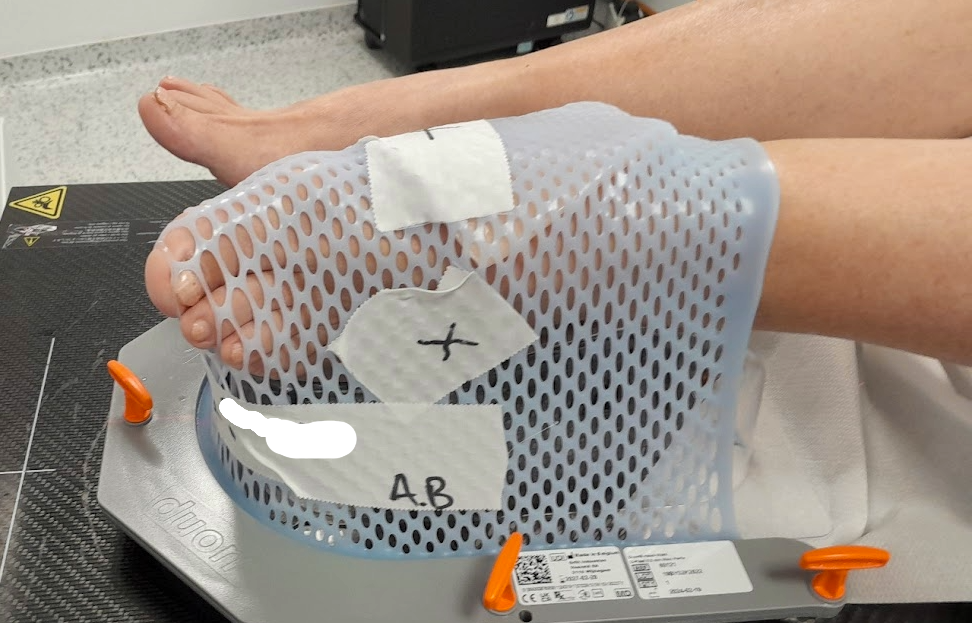
Case presentation: We report the case of a 74-year-old female patient with tumoral-stage Mycosis Fungoides presenting with a painful, ulcerated lesion on the plantar surface of the left foot. The patient was treated with intensity-modulated radiotherapy (IMRT) to a total dose of 30 Gy in 10 fractions, using a frog-leg position and thermoplastic immobilization with surface bolus to ensure reproducible setup and adequate dose coverage. Treatment was well tolerated and resulted in complete local response without significant acute toxicity. Follow-up Positron Emission Tomography–Computed Tomography (PET-CT) performed three months after treatment demonstrated complete metabolic remission of the irradiated lesion, although new lymph node involvement was detected.
Conclusion: This case confirms that localized radiotherapy using modern IMRT techniques can achieve durable local control and symptomatic relief in Mycosis Fungoides, while underlining the importance of multidisciplinary management for patients with systemic disease progression.