


Author(s) :
Ludovica Gandullia1, Irina Mihaela Cazacu2, Vlad Mihai Croitoru2, Paolo Gandullia3
1 Faculty of Medicine, Titu Maiorescu University, Bucharest, Romania
2 Department of Oncology, Fundeni Clinical Institute, Bucharest
3 Pediatric Gastroenterology and Endoscopy Unit, Integrated Department of Pediatric and Hemato-Oncological Sciences, IRCCS “G. Gaslini” Children’s Hospital, 16147 Genoa, Italy
Corresponding author: Ludovica Gandullia, Email: ludovicagandullia.lg@gmail.com
Publication History: Received - , Revised - , Accepted - , Published Online - December 2022.
Copyright: © The author(s). Published by Casa Cărții de Știință.
User License: Creative Commons Attribution – NonCommercial (CC BY-NC)

 PDF
PDF
 Share
Share
Highlights
• Malnutrition is highly prevalent in gastroesophageal cancer and directly undermines treatment tolerance, toxicity profiles, quality of life, and survival.
• Early, individualized interventions (dietary counselling, oral supplements, enteral feeding) can reduce hospitalisation, prevent treatment interruptions, and support functional recovery.
• Parenteral nutrition remains a selective, indication-driven strategy—reserved for non-functional GI tract or inadequate enteral intake—guided by prognosis, expected benefit, and patient goals.
Abstract
Nutritional support is an essential part of cancer care. Malnutrition is a common feature in cancer patients and has a negative impact on the quality of life and treatment tolerance. Patients with digestive cancers are at higher risk of malnutrition due to the gastrointestinal impairment caused by their disease. However, most of them have insufficient access to nutritional support.
Early identification of patients at risk of malnutrition is crucial in order to start an adequate nutritional support. Robust evidence showed that nutritional support can reduce length of hospitalisation, decrease treatment-related toxicity, and improve quality of life and physical function. Nutritional intervention can improve outcomes and help patients in the successful completion of oncological treatments by preventing malnutrition. The aim of this review is to provide a comprehensive overview of nutritional interventions for patients with gastroesophageal cancers.
1. Introduction
Malnutrition is a common feature in cancer patients and is the consequence of both the presence of the tumor and anticancer treatments. Almost one-fourth of cancer patients are at risk of dying because of malnutrition, rather than cancer itself (1). Moreover, malnutrition negatively impacts their quality of life and treatment toxicities (2).
Nutrition is considered a supportive therapy for cancer patients. Robust evidence indicates the benefits of professional nutritional support in improving nutrient intake, quality of life, and physical function in oncological patients (3, 4).
Experts recommend routinely using a nutritional screening, at diagnosis and throughout the course of disease, for detecting the risk of malnutrition and, if it is positive, to perform a complete nutritional assessment (5). There are different screening tools and methods to detect the nutritional risk. The nutritional needs of the cancer patients, except in those cases where individualized measures are required, should be considered similar to healthy individuals (i.e. 25– 30 kcal/kg/day). The nutritional monitoring of the cancer patient should be multidisciplinary. Parenteral nutrition (PN) is indicated mainly when it is not possible to use the digestive tract and/or oral feeding and/or enteral nutrition is not sufficient or possible (5).
Patients with digestive cancers are at higher risk of suffering of malnutrition due to the gastrointestinal impairment caused by their disease. The aim of this review is to provide a comprehensive overview of nutritional interventions for patients with gastroesophageal cancers.
2. Nutritional Status and Cancer Outcomes
Malnutrition, as defined by the World Health Organization (WHO), refers to deficiencies, excesses, or imbalances in a person’s intake of energy and/or nutrients. Malnutrition adversely affects the evolution of cancer patients, increasing the incidence of infections, length of hospital stays, and risk of death (6, 7).
Patients with cancer often have important nutritional deficiencies that significantly affect their quality of life (Table 1). In fact, the proportion of patients who at the time of diagnosis present with weight loss, ranges from 15 to 40% depending on the type of cancer (8).
According to the Spanish study NUPAC (9), the prevalence of moderate and severe malnutrition in patients with advanced cancer was 52%. Additionally, the incidence of malnutrition increases as the disease progresses until it affects 80% of patients (9).
Furthermore, malnutrition had an impact on hospital stay and costs, with an average stay of 3–4 days for malnourished patients, as compared to well-nourished ones and an increase in costs associated with hospitalization of 20–25% (10).
Malnutrition negatively impacts quality of life and treatment toxicities, and it has been estimated that up to 10-20% of cancer patients die due to consequences of malnutrition rather than due to the cancer itself (5).
A nutritional assessment is recommended for all cancer patients at diagnosis and during the treatment period in order to detect malnourished patients and to carry out an early intervention, since late diagnosis may make it difficult to recover and gain weight (11).
The ESPEN (European Society for Clinical Nutrition and Metabolism) guidelines, published in 2017 recommend periodically assessing nutrient intakes, weight, and body mass index (BMI), starting at the cancer diagnosis and with repeat evaluations based on the stability of the clinical situation (5).
Table 1. Causes Associated with Malnutrition in Cancer Patients (12)
| Tumor | Mechanical and functional alterations |
|---|---|
| The release of catabolic hormones, cytokines and mobilizing factors that favour hypermetabolism and cachexia | |
| Patient | Personal habits, physical deterioration, anorexia and psychological factors |
| Treatment | Side effects of the surgery, radiotherapy, chemotherapy and immunotherapy. Mucositis, emesis and diarrhea make intake difficult and favor malabsorption and loss of nutrients |
| Medical staff | Lack of nutritional assessment, poor knowledge, and training to detect malnutrition, delay in initiating adequate enteral and parenteral nutrition |
| Health authorities |
Absence of a professional planning. Deficit in the Nutrition Units and dietitians in the hospitals’ organigrams |
3. Screening for Nutritional Status
3.1. Screening tools
The most frequent nutritional screening tools used in clinical practice are the following:
- for hospitalized patients: Nutritional Risk Screening 2002 (NRS 2002) (13)
- for the general population: the malnutrition universal screening tool (MUST) (14)
- for the elderly patient, the mini nutritional assessment (MNA) (15) and the malnutrition screening tool (MST) (16) have been validated in hospitalized patients and outpatients on chemotherapy and radiation therapy.
In the Multidisciplinary Clinical Guidelines on Nutrition Management of the Cancer Patient published in Spain in 2008 (17), it was agreed to use MST as a nutritional screening for adult patients with cancer for its simplicity, reliability, and validity. The MST is composed of two questions: one related to weight loss and the other one to intake/appetite. Patients were classified into two groups: at risk of malnutrition (score ≥2) and without risk of malnutrition (score <2). Once the risk of malnutrition is detected, a complete nutritional assessment is required.
The most frequently used tool for nutritional assessment is the SGA-GP (subjective global rating generated by the patient) (18). It includes information on medical history (weight loss, dietary habits, gastrointestinal impairment) and physical examination (muscle mass, subcutaneous fat, edema). It also involves the patient himself who completes the part regarding the symptoms, the type of diet, and their daily activity. This classifies the patient into: (a) normonutrite, (b) at nutritional risk or moderate malnutrition and (c) severe malnutrition (18).
A combination of several clinical, analytical, anthropometric, and functional parameters should be considered to assess the initial and follow-up nutritional status of cancer patients (18). Clinical parameters, such as the tumor location (there is a greater nutritional risk in the digestive tract cancer) and the treatment received (greater risk with the use of concomitant treatments) have been identified together with the detection of signs such as anorexia, asthenia, decreased physical activity, nausea, diarrhea, steatorrhea or constipation, dysgeusia, pain, depression, or socioeconomic problems that hinder access to the food (12). The ESPEN guidelines recommend an assessment of muscle mass and fat reserves that can be performed by dual X-ray absorptiometry (DEXA) or bioimpedance analysis (BIA), as well as an assessment of physical performance using various scales such as the ECOG or Karnofsky score (5).
The analytical parameters frequently associated with nutritional status are C reactive protein, albumin and prealbumin; however, they should be evaluated in the global context as they can be altered by other intercurrent and common problems in cancer patients. The ESPEN guidelines recommend the use of serum C-reactive protein (CRP) and albumin to measure systemic inflammation (5, 19).
Among the anthropometric parameters, significant weight loss defined as more than 10% in 6 months or 5% in3 months are considered the most reliable indicator of nutritional deficit. Another accessible anthropometric indicator is the measurement of the brachial circumference, as a method to evaluate for muscle mass loss. A measurement of less than 20 cm or a decrease of more than 2 cm between two determinations, suggests malnutrition (5). Other more precise tools are not available.
3.2. Indication of nutritional support
Nutritional support is classified according to its aggressiveness and complexity, and the following methods are included:
- A. Nutritional recommendations and hygienic-dietary advice.
- B. Artificial nutrition:
- a. Supplementation with oral enteral nutrition (ONS).
- b. Enteral nutrition by tube.
- c. Parenteral nutrition (PN).
The method of choice depends on the patient’s current situation: oncologic diagnosis, cancer treatment, prognosis, nutritional status, nutritional requirements, and duration of nutritional support (Figure 1). In cancer patients, nutritional support is indicated when there is malnutrition, the patient is not expected to be able to eat food for a week or more, or if their intake is less than 60% of their needs for more than 10 days (5).
Figure 1. Nutritional Support Algorithm (Adapted from Hernàndez et al.(17))
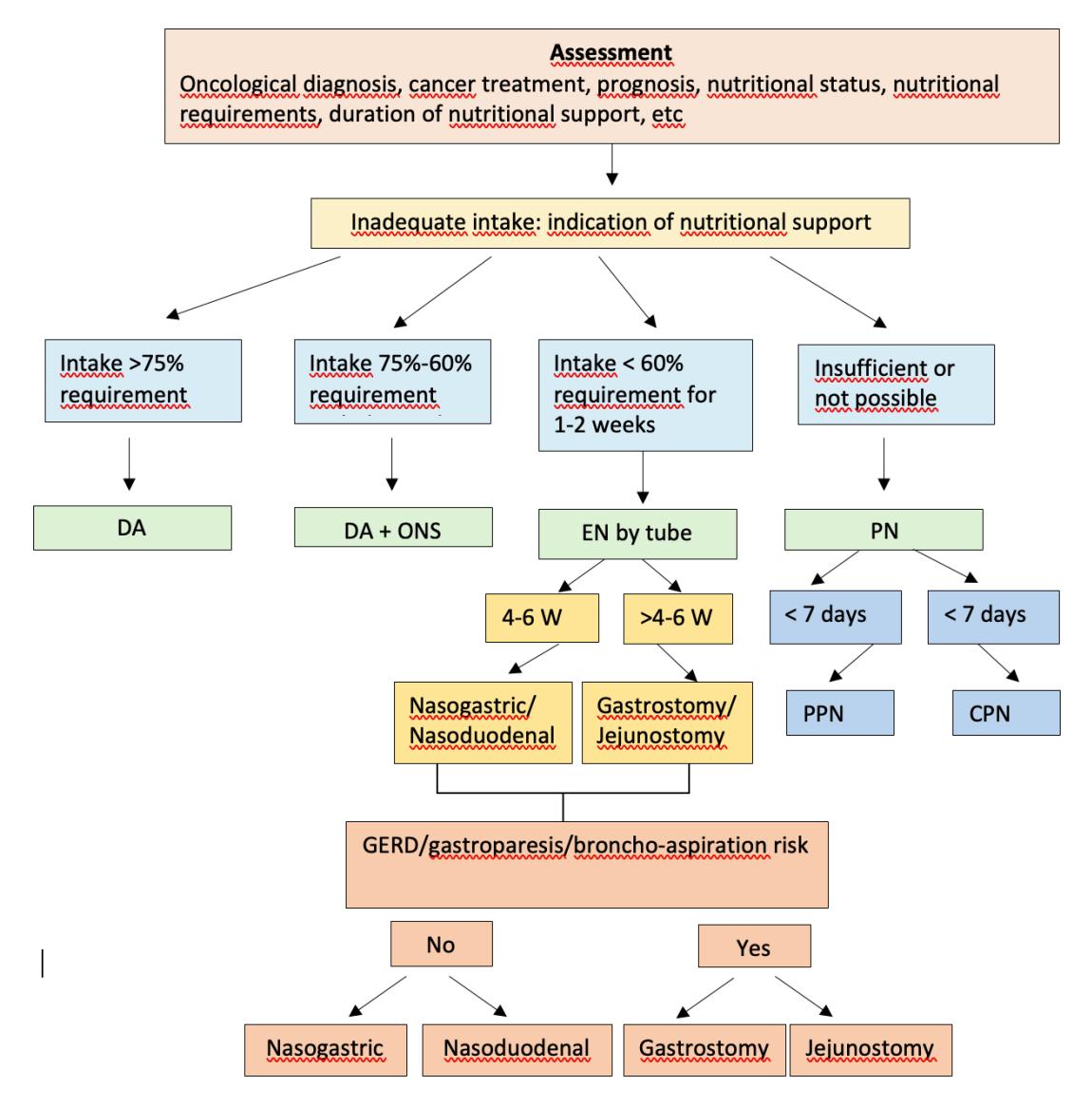
DA dietetic advice. ONS oral nutritional supplements. EN enteral nutrition. PN parenteral nutrition. W weeks. NasoEnt nasoenteral. PPN peripheral parenteral nutrition. CPN central parenteral nutrition. GERD gastro esophageal reflux disease.
3.3. Nutritional requirements in cancer patients
The energetic requirements of cancer patients should be considered similar to those of healthy people (25–30 kcal/kg/day), if individualized measures are not performed (12, 20). It should be taken into consideration that this approach is often overestimated in obese people and underestimated particularly in thin patients. Protein requirements are advised to be between 1 (minimum) and 1.2–1.5 g/kg/day and if there is protein catabolism it can be increased to 2 g/kg/day (12). The ideal lipid/carbohydrate ratio will be determined by the clinical situation or medical history of each patient. If there is insulin resistance it is recommended for this relationship to shift in favour of lipids, because of increased glucose oxidation and weight loss (12).
It is also important to take into consideration the water and sodium needs, which should be below normal (30 ml/kg/day for water and 1 mmol/kg/day for sodium) in the case of peritoneal carcinomatosis with obstruction or ascites, for avoiding overload or third space (5, 12).
Regarding vitamins and trace elements, if there are no specified deficits it is not suggested to supplement in amounts higher than the recommended daily doses (5, 12)
3.4. Pharmaconutrition
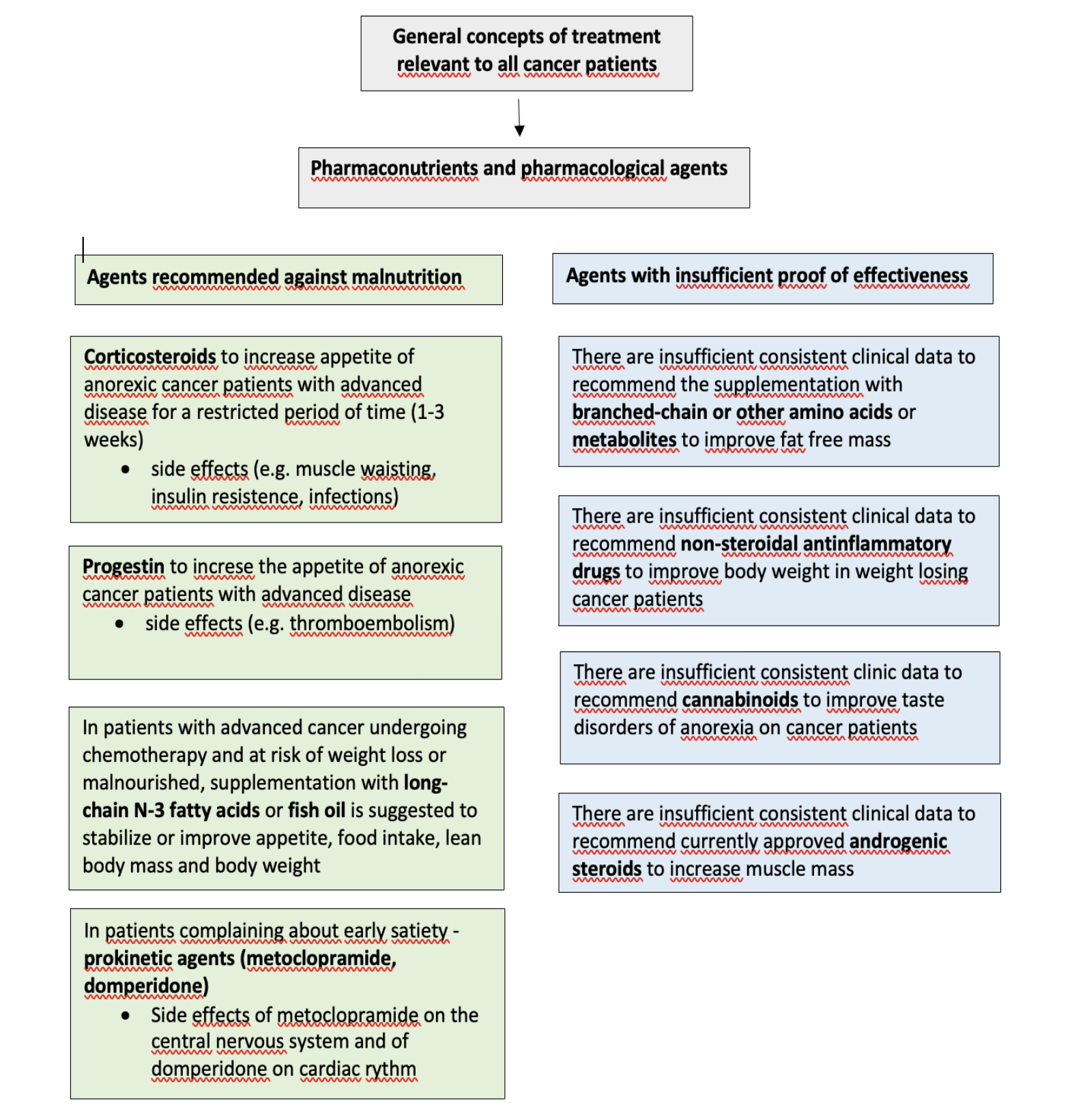
The specific nutrients or ”pharmaconutrients” are nutritional substrates that in addition to their nutritional value have other benefits for the organism. They are used to modulate the course of the disease, for example, omega 3 fatty acids, arginine, or glutamine. ESPEN guidelines suggest using supplementation only of omega 3 fatty acids in advanced cancer patients to stabilize or improve appetite, food intake, lean body and body weight (5).
The pharmaconutrients and pharmacological agents recommended by ESPEN for cancer patients are summarized in Figure 2 (5).
Figure 2. Pharmaconutrients and Pharmacological Agents Used for Nutritional Support in Cancer Patients (Adapted from Arends et al. (5))
3.5. Indications of parenteral nutrition
PN, as a specific nutritional support modality in the cancer patients, is indicated mainly when it is not possible to use the digestive tract and/or oral feeding and/or enteral nutrition is not sufficient or possible.
The main indications of PN in cancer patients are the following:
- a. Difficult access to the digestive tract: perforation, intestinal obstruction, or chylothorax
- b. Impossibility of access to the digestive tract: high-throughput entero-cutaneous fistulas, paralytic ileus, digestive haemorrhage, or insufficient absorptive surface
- c. Ineffective digestive tract: short bowel syndrome, high-throughput fistulas, intestinal insufficiency due to radiation-induced enteritis
- d. Low oral and/or enteral intake: less than 60% of the nutritional needs for more than 1–2 weeks and an improvement in the nutritional status and quality of life is foreseen.
When the estimated survival is greater than 1–3 months, and in case of intestinal insufficiency, PN can be offered, if the oral/enteral route is insufficient and there are expectations of improvement in the patient’s quality of life and functionality and with an express desire of this one (5).
4. Nutritional Support Strategies for Patients with Early-Stage Gastroesophageal Cancer (resectable)
According to ESPEN guidelines (5), all cancer patients undergoing either curative or palliative surgery should be managed within an enhanced recovery after surgery (ERAS) program; as part of this program, every patient should be screened for malnutrition and given additional nutritional support if at risk. The main recommendations include pre-operative fluid and carbohydrate load, avoidance of fasting, and reintroduction of oral diet on the first postoperative day (5, 21).
Patients who are at moderate or high nutritional risk, particularly those undergoing surgery for upper GI cancer, should be considered for routine post-operative nutritional support (by oral or enteral route, as appropriate), and consideration should be given to continuing this support once the patient is discharged (22).
4.1. Upper GI cancer patients
ESPEN guidelines recommend oral/enteral immuno-nutrition (arginine, n-3 fatty acids, nucleotides) in upper GI cancer patients undergoing surgical resection (5). It was demonstrated that upper GI cancer patients experienced a reduction in post-operative infective complications when given oral/enteral “immune-modulating nutrition” in the peri-operative period. The term “immunemodulating nutrition” or “immuno-nutrition” refers to liquid nutritional supplements enriched with specific nutrients (arginine, n-3 fatty acids, nucleotides) (23).
Preoperative nutritional support is indicated for patients with dysphagia or significant weight loss during induction therapy. NCCN guidelines recommend a feeding jejunostomy tube since placement of a gastrostomy tube may compromise the integrity of gastric conduit for reconstruction (24). A percutaneous gastrostomy tube may be considered for patients with cervical esophageal tumors receiving definitive chemoradiation. Multidisciplinary expertise is recommended prior to placement of a feeding tube (24).
4.2. Radiotherapy
During radiotherapy, an adequate nutritional intake should be achieved by individualized nutritional counselling and/or with use of oral enteral nutrition (ONS) in order to prevent nutritional deterioration, maintain intake and avoid radiotherapy interruptions.
All patients undergoing radiation of the GI tract should receive a comprehensive nutritional assessment, adequate nutritional counselling and, if necessary, nutritional support according to symptoms and nutritional status. If nutritional support is required, this should be initiated early and if energy intake is inadequate, ONS are recommended (5).
In radiation-induced severe mucositis, ESPEN recommended enteral nutrition (EN) using nasogastric or percutaneous tubes (e.g. percutaneous endoscopic gastrostomies (PEG)). In patients with obstructing esophageal cancers and in settings with expected severe radiationinduced oral or esophageal mucositis, there is a high risk for weight loss, decreased physical performance, dehydration, decreased treatment tolerance and increased treatment interruptions.
In high-risk situations (T4 tumor, female sex, or combined chemoradiotherapy), prophylactic EN (as opposed to enteral feeding initiated after the onset of dysphagia) may maintain nutritional status and prevent interruption of treatment. Several, mostly retrospective observational studies observed improved body weight and lower rates of rehospitalization and treatment interruptions for patients treated with early compared to later or no EN (25, 26). PEG compared to radiologically inserted gastrostomies (RIG) appear to be associated with a lower risk of peritonitis and mortality. PEG, in comparison with nasogastric tubes, show that body weight may be maintained similarly, risk of tube dislodgement is lower and quality of life is possibly better. Nasogastric tubes are associated with less dysphagia and earlier weaning after completion of radiotherapy (25). The risks of pneumonia and other infections are similar (5, 25).
5. Nutritional Support Strategies for Patients with Metastatic Gastroesophageal Cancer
Nutritional support is important in the palliative setting as well since malnutrition and sarcopenia can lead to decreased survival and deterioration of quality of life. According to ESPEN guidelines, nutritional therapy in the palliative setting is beneficial as long as the patient is at higher risk of an earlier death due to malnutrition rather than cancer (5, 27). In this setting, nutritional support should improve quality of life and control symptoms.
Although guidelines always recommend a gradual transition from the less invasive (dietary counselling and ONS) to the more invasive nutritional intervention (PN), a compromised gastrointestinal tract may lead to select PN as the initial intervention, often combined to oral food intake to meet nutritional requirements (28). PN is mandatory in cases of complete bowel obstruction to prevent death from starvation and dehydration and could potentially improve quality of life and prolong survival. Whenever possible, it is important to maintain even a minimum intake of nutrients per os (e.g., complex carbohydrates, liquids), with the aim to support the mucosal immune response (29, 30).
For most patients with advanced disease who have an estimated life span that is measured in weeks to months, guidelines recommend against the use of enteral or total parenteral nutritional support (5). The routine use of nutritional support in patients with advanced incurable cancer is associated with a higher risk of treatment-related complications, and no evidence of a survival benefit, although the quality of the evidence is low (2,3,109-113).
However, in highly selected patients (e.g.., high-grade bowel obstruction or malabsorption from advanced cancer) who might otherwise have a prognosis that is measured in several months or years, home parenteral nutritional support may be considered after extensive deliberation among the health care staff, the patient, and caregivers (5). Even under such circumstances, however, parenteral nutrition is the exception rather than the rule,
EN should be considered if the gastrointestinal tract is functional, in the case of a life expectancy of several weeks or months. Endoscopic or surgical jejunostomy may be an option in the case of gastric obstruction/ dysmotility, whereas a nasogastric tube or a nasojejunal tube could be considered when short-term EN is expected (usually up to 6 weeks) and/or survival is uncertain (31, 32). When EN is unfeasible or refused by the patients, according to ESPEN 2009 and 2020 guidelines (33, 34) , PN should be considered for patients with life expectancy between 1 and 3 months.
6. Conclusions
Nutritional support is an essential component of management in upper gastrointestinal cancer, however there is limited knowledge of current clinical practice. Each patient should undergo the screening for assessment of nutritional status and should be treated following his specific needs according to the nutritional support algorithm and ESPEN guidelines. Timely nutritional support may positively impact the nutritional parameters and nutritional status of the patient, the quality of life, and tolerance to therapies.
Abbreviations
BIA – bioimpedance analysis
BMI – body mass index
CPN – central parenteral nutrition
CRP – C-reactive protein
DA – dietetic advice
DEXA – dual X-ray absorptiometry
EN – enteral nutrition
ERAS – enhanced recovery after surgery
ESPEN – European Society for Clinical Nutrition and Metabolism
GERD – gastro esophageal reflux disease.
GI – gastrointestinal
MNA – mini nutritional assessment
MST – malnutrition screening tool
MUST – malnutrition universal screening tool
NCCN – National Comprehensive Cancer Network
NRS – Nutritional Risk Screening
ONS – oral enteral nutrition
PEG – percutaneous endoscopic gastrostomy
PPN – peripheral parenteral nutrition
PN – parenteral nutrition
RIG – radiologically inserted gastrostomy
SGA-PG – patient-generated subjective global rating
QoL – quality of life
WHO – World Health Organization
Statements:
Authors’ contributions: L.G and I.M.C conceived and planned the review; L.G, I.M.C and V.M.C wrote the manuscript. P.G reviewed the manuscript and made the final approval. All authors provided critical feedback and helped shape the research, analysis, and manuscript.
Consent for publication: As the corresponding author, I confirm that the manuscript has been read and approved for submission by all named authors
Conflict of interests: The authors declare no conflict of interest
Funding Sources: None
Statement of Ethics: The manuscript does not contain any studies carried out by the authors on humans or animals
References:
- Muscaritoli, M., et al., ESPEN practical guideline: Clinical Nutrition in cancer. Clinical Nutrition, 2021. 40(5): p. 2898- 2913.
- Van Cutsem, E. and J. Arends, The causes and consequences of cancer-associated malnutrition. European journal of oncology nursing, 2005. 9: p. S51-S63.
- Senesse, P., et al., Nutritional support during oncologic treatment of patients with gastrointestinal cancer: who could benefit? Cancer treatment reviews, 2008. 34(6): p. 568-575.
- Prado, C.M., et al., Examining guidelines and new evidence in oncology nutrition: A position paper on gaps and opportunities in multimodal approaches to improve patient care. Supportive Care in Cancer, 2021: p. 1-11.
- Arends, J., et al., ESPEN guidelines on nutrition in cancer patients. Clinical nutrition, 2017. 36(1): p. 11-48.
- Kelsen, D.P., et al., Chemotherapy followed by surgery compared with surgery alone for localized esophageal cancer. New England Journal of Medicine, 1998. 339(27): p. 1979-1984.
- Alves, A., et al., Postoperative mortality and morbidity in French patients undergoing colorectal surgery: results of a prospective multicenter study. Archives of surgery, 2005. 140(3): p. 278-283.
- Vitaloni, M., et al., The impact of nutrition on the lives of patients with digestive cancers: a position paper. Supportive Care in Cancer, 2022. 30(10): p. 7991-7996.
- Segura, A., et al., An epidemiological evaluation of the prevalence of malnutrition in Spanish patients with locally advanced or metastatic cancer. Clinical Nutrition, 2005. 24(5): p. 801-814.
- Planas, M., et al., Prevalence of hospital malnutrition in cancer patients: a sub-analysis of the PREDyCES® study. Supportive Care in Cancer, 2016. 24(1): p. 429-435.
- Valenzuela-Landaeta, K., P. Rojas, and K. Basfi-Fer, Evaluación nutricional del paciente con cáncer. Nutrición hospitalaria, 2012. 27(2): p. 516-523.
- Virizuela, J., et al., Nutritional support and parenteral nutrition in cancer patients: an expert consensus report. Clinical and translational oncology, 2018. 20(5): p. 619-629.
- Kondrup, J., et al., Nutritional risk screening (NRS 2002): a new method based on an analysis of controlled clinical trials. Clinical nutrition, 2003. 22(3): p. 321-336.
- Chao, P.-C., et al., The Malnutrition Universal Screening Tool (MUST) and a nutrition education program for high risk cancer patients: strategies to improve dietary intake in cancer patients. Biomedicine, 2015. 5(3): p. 1-6.
- Guigoz, Y. and B. Vellas. The Mini Nutritional Assessment (MNA) for grading the nutritional state of elderly patients: presentation of the MNA, history and validation. in Nestle Nutr Workshop Ser Clin Perform Programme. 1999.
- Shaw, C., et al., Comparison of a novel, simple nutrition screening tool for adult oncology inpatients and the Malnutrition Screening Tool (MST) against the Patient-Generated Subjective Global Assessment (PG-SGA).Supportive care in cancer, 2015. 23(1): p. 47-54.
- Hernández, J.Á., et al., Documento de consenso. Nutrición Hospitalaria, 2008. 1(1): p. 13-48.
- Reber, E., et al., Nutritional Risk Screening and Assessment. J Clin Med, 2019. 8(7).
- Davis, C.J., et al., The use of prealbumin and C-reactive protein for monitoring nutrition support in adult patients receiving enteral nutrition in an urban medical center. JPEN J Parenter Enteral Nutr, 2012. 36(2): p. 197-204.
- Dewys, W., L. Pt, And B. Jm, Prognostic Effect of Weiglet Loss Prior to Chemotherapy in Cancer Patients. 1980.
- Mortensen, K., et al., Consensus guidelines for enhanced recovery after gastrectomy. Journal of British Surgery, 2014. 101(10): p. 1209-1229.
- Beattie, A., et al., A randomised controlled trial evaluating the use of enteral nutritional supplements postoperatively in malnourished surgical patients. Gut, 2000. 46(6): p. 813-818.
- Marimuthu, K., et al., A meta-analysis of the effect of combinations of immune modulating nutrients on outcome in patients undergoing major open gastrointestinal surgery. 2012, LWW. p. 1060-1068.
- Ajani, J.A., et al., Esophageal and esophagogastric junction cancers, version 4.2022, NCCN clinical practice guidelines in oncology. Journal of the National Comprehensive Cancer Network, 2022.
- Wang, J., et al., Percutaneous endoscopic gastrostomy versus nasogastric tube feeding for patients with head and neck cancer: a systematic review. Journal of radiation research, 2014. 55(3): p. 559-567.
- Mekhail, T.M., et al., Enteral nutrition during the treatment of head and neck carcinoma: is a percutaneous endoscopic gastrostomy tube preferable to a nasogastric tube? Cancer: Interdisciplinary International Journal of the American Cancer Society, 2001. 91(9): p. 1785-1790.
- Cotogni, P., et al., The role of nutritional support for cancer patients in palliative care. Nutrients, 2021. 13(2): p. 306.
- Bozzetti, F., Is there a place for nutrition in palliative care? Supportive Care in Cancer, 2020. 28(9): p. 4069-4075.
- Quiroz-Olguín, G., et al., The effect of enteral stimulation on the immune response of the intestinal mucosa and its application in nutritional support. European Journal of Clinical Nutrition, 2021. 75(11): p. 1533-1539.
- Mulazzani, G.E.G., et al., Nutritional Support Indications in Gastroesophageal Cancer Patients: From Perioperative to Palliative Systemic Therapy. A Comprehensive Review of the Last Decade. Nutrients, 2021. 13(8).
- Mendelsohn, R.B., et al., Carcinomatosis is not a contraindication to enteral stenting in selected patients with malignant gastric outlet obstruction. Gastrointestinal endoscopy, 2011. 73(6): p. 1135-1140.
- Min, S.-H., et al., Laparoscopic gastrojejunostomy versus duodenal stenting in unresectable gastric cancer with gastric outlet obstruction. Annals of surgical treatment and research, 2017. 93(3): p. 130-136.
- Staun, M., et al., ESPEN Guidelines on Parenteral Nutrition: home parenteral nutrition (HPN) in adult patients. Clinical nutrition, 2009. 28(4): p. 467-479.
- Pironi, L., et al., ESPEN guideline on home parenteral nutrition. Clinical nutrition, 2020. 39(6): p. 1645-1666.